
古代战船:当战场来到了水上
Ancient Warships: When the Battlefield Moved onto Water
Page 1
一支“投降”的船队
A Fleet Coming to Surrender

At Red Cliffs, burning ships race with the strong wind toward the connected fleet.
大约一千八百年前,Cáo Cāo · 东汉末年的政治家、军事家和诗人。带着一支大军来到Cháng Jiāng · 中国最长的河流。边,准备继续向南。很多士兵来自北方。他们会在陆地上打仗,却不习惯在水上作战。一路行军后,军中还有很多人生病了。江对面,Zhōu Yú · 东吴将领,赤壁之战中统领吴军。和他的军队准备拦住他们。
一本很早的史书说,曹操的许多船首尾相连,却没有说为什么。很久以后,小说《三国演义》说,北方士兵坐船容易晕,所以曹操把船用铁链连起来,让甲板更稳。不过,这是小说里的说法,不是那本早期史书记下的原因。
Huáng Gài · 三国时期东吴将领,赤壁之战中率火船冲向曹军。发现了一个危险:如果一艘木船起火,旁边连着的船可能来不及逃开。
黄盖给曹操送去一封信。他假装要投降,说自己愿意加入曹操的军队。可是,他准备的船里偷偷装满了干草、木柴和油。
这些船靠近时,曹操的士兵以为黄盖真的来投降了。黄盖却下令点火。强风把燃烧的船吹向曹操的船队。大火从一艘船烧到另一艘船,还烧到了岸边的营地。曹操的军队只好撤退。
这场战斗就是著名的赤壁之战。它告诉我们一件重要的事:水战中,船不只是把士兵送到战场,船自己也是战斗的一部分。
船要在水和风中前进,还要躲开敌人的攻击。
About 1,800 years ago, Cáo Cāo · 曹操 · A powerful leader, commander, and poet at the end of the Eastern Han dynasty. led a large army to the Cháng Jiāng · 长江 · China's longest river.. Many of his soldiers came from northern China. They knew how to fight on land, but they were not used to fighting on water. The long journey had also made many of them sick. Across the river, Zhōu Yú · 周瑜 · The Eastern Wu commander who directed Wu forces at the Battle of Red Cliffs. and his army were ready to stop them.
An old history book says that many of Cao Cao’s ships were tied together from front to back. It does not tell us why. Much later, the novel Romance of the Three Kingdoms said the ships were chained together to make the decks steadier for soldiers who became sick on boats. But that explanation comes from the novel, not the older history book.
Huáng Gài · 黄盖 · The Eastern Wu commander who led fire ships toward Cao Cao's fleet at Red Cliffs. saw a weakness. If one wooden ship caught fire, the ships tied beside it might not be able to move away.
Huang Gai sent Cao Cao a letter. He pretended that he wanted to give up and join Cao Cao’s side. But his ships were secretly filled with dry grass, firewood, and oil.
When the ships came closer, Cao Cao’s soldiers thought Huang Gai was really coming to surrender. Then Huang Gai ordered his men to set the ships on fire. A strong wind pushed the burning ships toward Cao Cao’s fleet. The fire spread from ship to ship and reached the camp on shore. Cao Cao’s army had to retreat.
This became known as the Battle of Red Cliffs. It shows us something important about fighting on water: ships did not just carry soldiers into battle. The ships were part of the battle.
They had to move through water and wind. They also had to survive enemy attacks.
Page 2
首先,船得听话
First, Make the Ship Go Where You Want
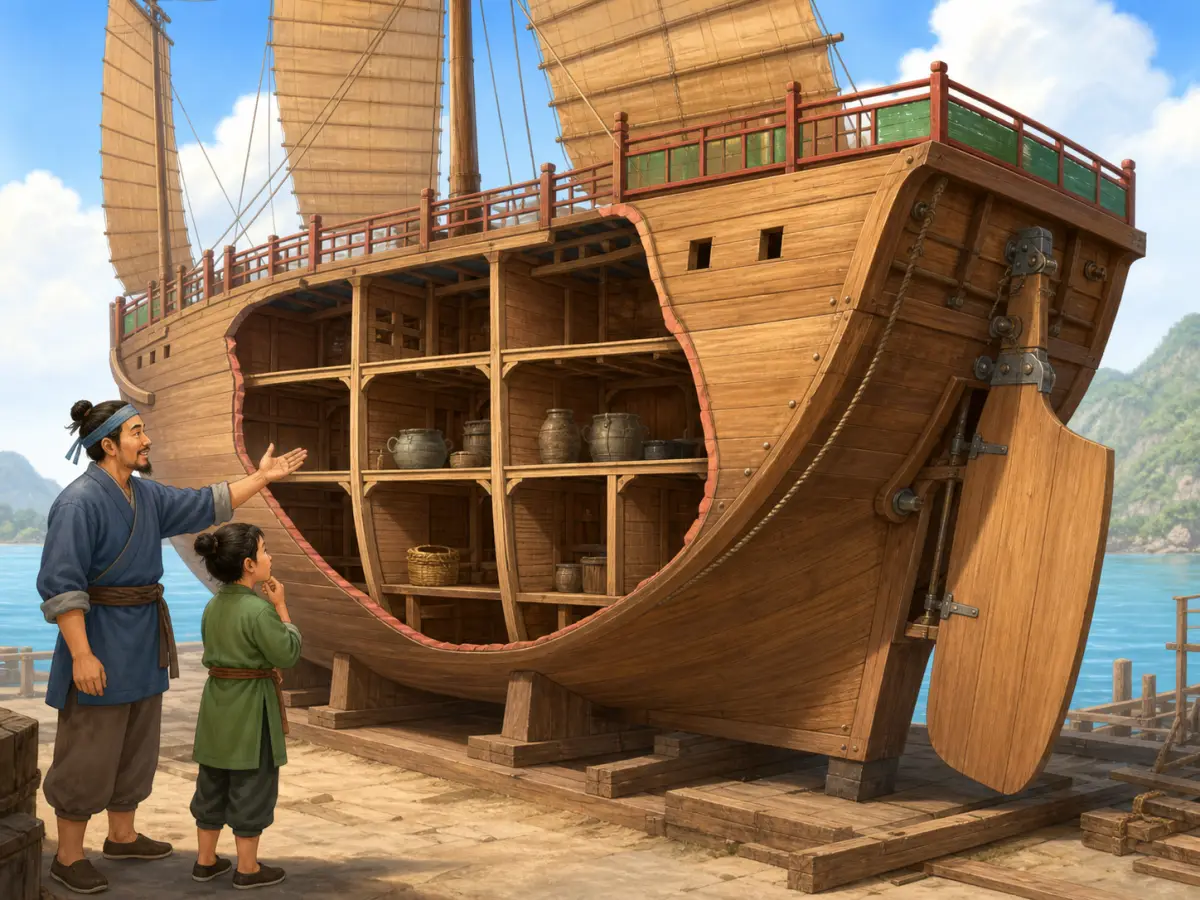
A cutaway ship shows the rudder at the stern and the bulkheads dividing the hull.
一艘不会转弯的船,很难在战斗中派上用场。一千八百多年前,中国已经有把舵装在船尾的船。广州出土的一件东汉陶船模型上,就可以清楚看到船尾的舵。
今天我们看见船舵,可能觉得再普通不过。可是古代的船没有发动机。风、船桨和水流一起推着船走,怎样让一艘大木船在合适的时候转向,是一件很重要的事。
水上作战时,船可能要靠近另一艘船,也可能突然掉头,还可能要顶着水流回到岸边。船上的士兵能不能到达想去的地方,首先要看掌船的人能不能控制这艘船。
A boat that cannot turn is not much use in a fight. More than 1,800 years ago, Chinese craftspeople were already making ships with a rudder at the stern. We can see one clearly on an Eastern Han clay ship model found in Guangzhou. The model even shows the rudder fixed at the back of the vessel, where it could help control the ship’s direction.
That might sound ordinary today. Almost every large modern ship has a rudder. But imagine steering without an engine. A wooden vessel might be moving with sails, oars, or poles while wind and current pushed it another way. Turning at the right moment mattered.
On a river battlefield, one ship might need to move toward another, pull away, turn across the current, or find a safe way back to shore. The people fighting aboard the ship depended on the people who could make it move.
Page 3
船破了一个洞怎么办?
What If Water Gets Inside?
木船还有一个更麻烦的问题:进水。后来,中国造船工匠发展出了一种很聪明的办法。他们用一道道坚固的舱壁,把船里面分成许多独立的船舱。
这样,如果其中一个船舱破损进水,舱壁可以帮助挡住水,不让它一下子灌进整条船。
考古学家在中国古船上发现了这种结构。江苏出土的一艘Táng cháo · 618年至907年的中国朝代。木船已经有水密舱壁,后来这种技术也成了中国传统木船很重要的一部分。一格一格的船舱还能让船身更加结实,也方便分开放置人员、粮食和其他东西。
从里面看,一艘大船就不再像一个空空的大木盒子,而更像许多小房间一起浮在水上。
There was another problem that every wooden ship had to fear: a leak. Over the centuries, Chinese shipbuilders developed hulls divided by strong walls called bulkheads. Instead of leaving the inside of the ship as one huge open space, they separated it into compartments.
This mattered when something went wrong. If one compartment was damaged and filled with water, the bulkheads could help keep that water from spreading immediately through the entire ship.
Archaeologists have found this kind of construction in ancient Chinese ships. A wooden boat excavated in Jiangsu and dated to the Táng cháo · 唐朝 · The Chinese dynasty that lasted from 618 to 907. had watertight compartments, and the technology became an important part of later Chinese wooden shipbuilding. The compartments had another advantage too: they helped strengthen the hull and gave people separate spaces for supplies and cargo.
A warship was beginning to look less like one hollow wooden box and more like a row of strong rooms floating together.
Page 4
泥里真的挖出了一艘战船
A Real Warship Comes Out of the Mud
古书里有许多战船的名字和故事,可真正的木船很难保存几百上千年。1984年,Shāndōng · 中国东部沿海省份。Pénglái · 山东沿海城市,古港遗址出土过木船。古港清理淤泥时,人们却发现了一艘埋在泥里的古船。
留下来的船身足足有28.6米长。十三道舱壁把里面分成十四个船舱。考古人员还发现了铁剑、石制弹丸和早期火器等物品。根据船的形状和出土物,人们判断它是一艘古代战船。
它上面的桅杆、船帆和甲板早已不见了,留下来的主要是埋在下面的船身。可是,正是这部分让人看清了一件事:一艘战船首先要足够结实,要能控制进水,还要载得动人、武器和各种用品。
For a long time, ancient warships were known mostly from old books, pictures, and models. Then mud at Pénglái · 蓬莱 · A coastal place in Shandong where wooden ships were excavated from an old harbor., on the coast of Shāndōng · 山东 · A coastal province in eastern China., gave archaeologists something much more solid. During work at the old harbor in 1984, the remains of a large wooden ship were found buried below the water and mud.
About 28.6 meters of the hull survived. Inside, thirteen bulkheads divided the ship into fourteen compartments. Archaeologists also found objects connected with military use, including an iron sword, stone ammunition, and early huǒyào · 火药 · The explosive mixture whose Chinese name literally means fire medicine. weapons. The long, narrow shape of the vessel helped researchers identify it as a warship used many centuries ago.
The upper decks, sails, and masts were gone. What remained was the part that had spent centuries hidden underneath everything else: the wooden body of the ship. And inside that body were the same kinds of problems shipbuilders had been trying to solve for generations. The vessel needed to stay strong, keep water under control, carry people and equipment, and move through the sea.
Page 5
木船上的战场
Fire, Water, and Wood
再回到赤壁。黄盖的火攻之所以有效,不是因为他的船更大,而是因为他看出了曹军船只首尾相接的破绽。火船借着强风冲过去,大火一旦蔓延,连在一起的木船就更难躲开。
到了水上,战争就和陆地不一样了。河水会推船,风会改变火势,木头会燃烧,一条船破了以后还可能进水。士兵当然重要,可造船的人、掌舵的人,还有船本身,也都决定着接下来会发生什么。
赤壁的大火早已熄灭了一千多年。后来,蓬莱泥土里留下的那艘战船,却让人重新看见了古代船工做过的事情:一块块木板、一排排船舱,还有一艘为了在水上行动而仔细造出来的船。
战船在开始打仗以前,首先得是一艘好船。
Go back now to Red Cliffs. Huang Gai’s attack did not work because his ships were larger. It worked because he recognized the weakness of a fleet joined bow to stern. Once the burning ships raced forward with the wind, the connected wooden vessels had less room to escape the spreading fire.
That is what makes ancient naval warfare different from simply putting an army on boats. The water was part of the battlefield. So was the weather. And every wooden ship had strengths and weaknesses of its own.
Centuries after the fires at Red Cliffs disappeared, one old warship lay buried in the mud at Penglai. When archaeologists uncovered its long wooden hull and its row of compartments, they could finally see something an old battle story does not show very well:
Before a warship could fight, it first had to be a very good ship.