长城不只是一堵墙
The Great Wall Is More Than One Wall
Page 1
哪一个是长城?
Which One Is the Great Wall?
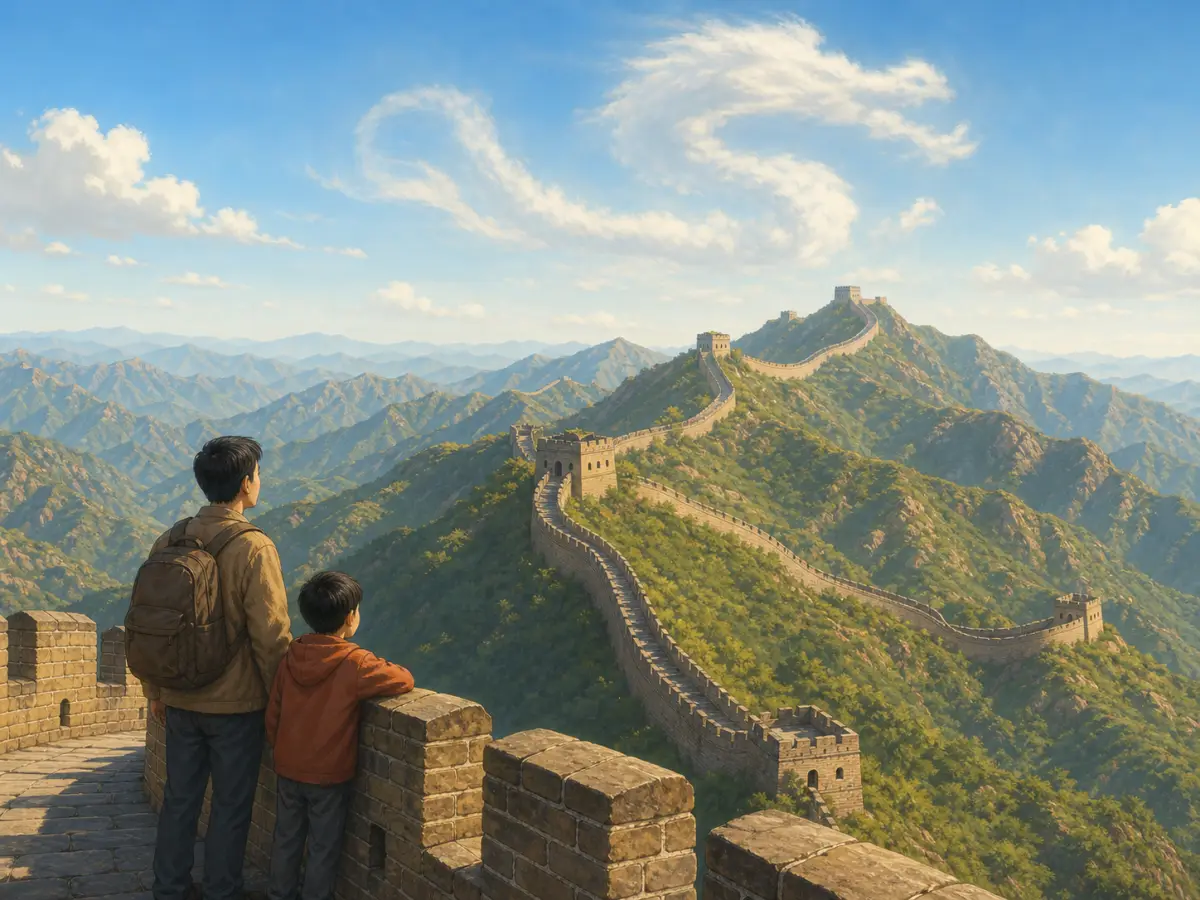
This imagined Ming-style Wall near Beijing does not represent every Great Wall site.
北京附近的山上,有高高的砖墙和一座座敌楼。很多人一想到长城,就想到这个样子。
可是在甘肃的沙漠里,一道低低的土墙也可能属于长城。有些地方只剩壕沟、烽火台、关口或城堡。
长城不是一条从头到尾完整的墙。很多朝代在不同地方修建、使用、放弃或改造了不同防线。
On mountains near Beijing, tall brick walls run past tower after tower. Many people picture this scene when they hear “the Great Wall.”
In the Gansu desert, however, a low ridge of earth may also belong to Great Wall history. Some places have only a ditch, beacon mound, pass, or fort.
The Great Wall is not one complete wall from beginning to end. Many governments built, used, left, and changed different frontier lines.
Page 2
土、沙、芦苇和砖
Earth, Sand, Reeds, and Brick
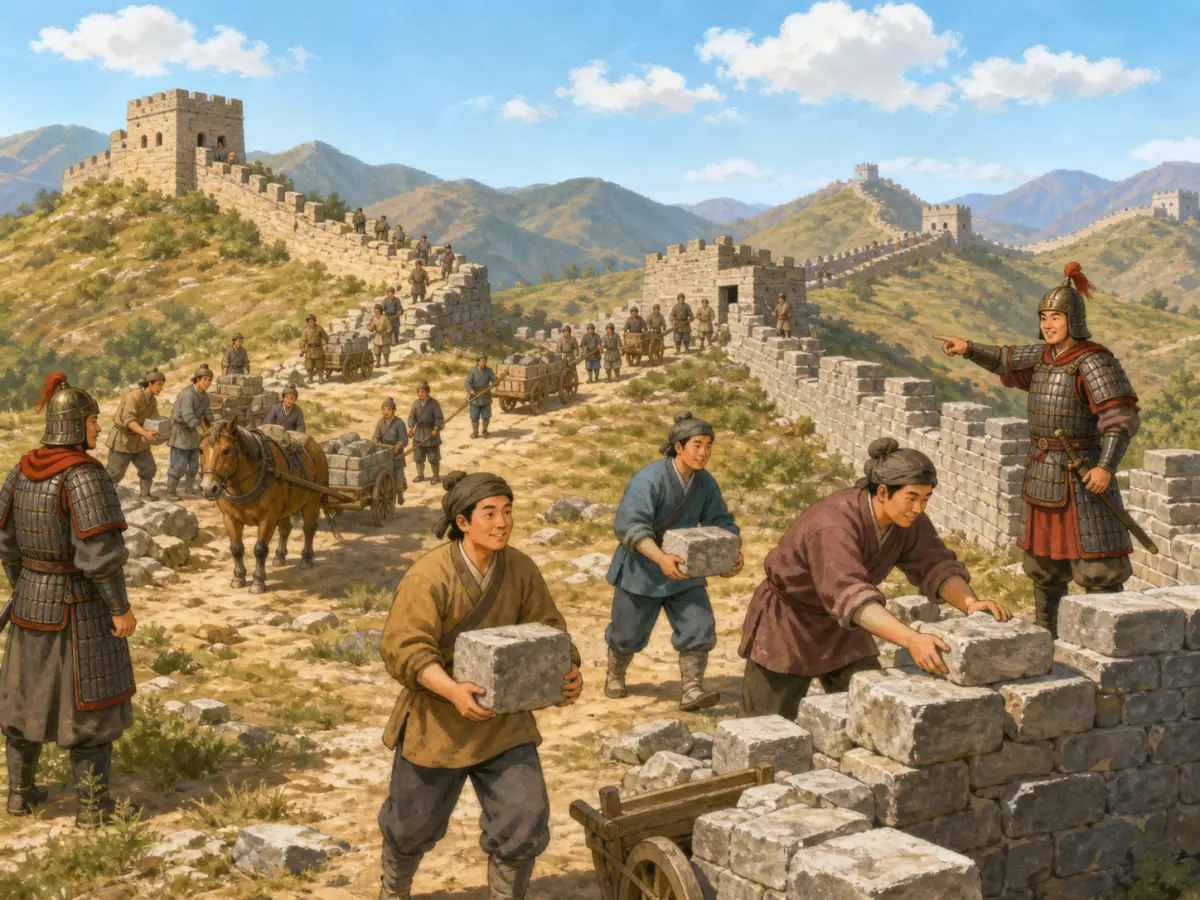
This imagined masonry work site looks later than the Qin. It is not a Qin construction scene.
两千多年前,战国的许多国家修过自己的墙。它们方向不同,有时防北方骑马人群,有时防旁边的国家。
秦始皇统一以后,政府利用一些旧墙,也修建新段。秦代常用当地泥土夯筑,不是今天游客走的明代砖墙。
汉代在西边沙漠里会用土、砂砾、芦苇和红柳。明代又在北京附近用砖石加固。工匠总要使用当地能找到的材料。
More than two thousand years ago, several Warring States built walls of their own. They faced different directions. Some guarded against northern riders, while others defended one state from a neighbor.
After the First Emperor united the states, the Qin government reused some old walls and built new sections. Qin builders often packed local earth into hard layers. Tourists today usually walk on much later Ming brickwork.
Han builders in western deserts used earth, gravel, reeds, and red willow. Ming builders strengthened areas near Beijing with brick and stone. Makers worked with materials they could find nearby.
Page 3
烟火怎样传消息?
How Did Smoke and Fire Carry a Warning?
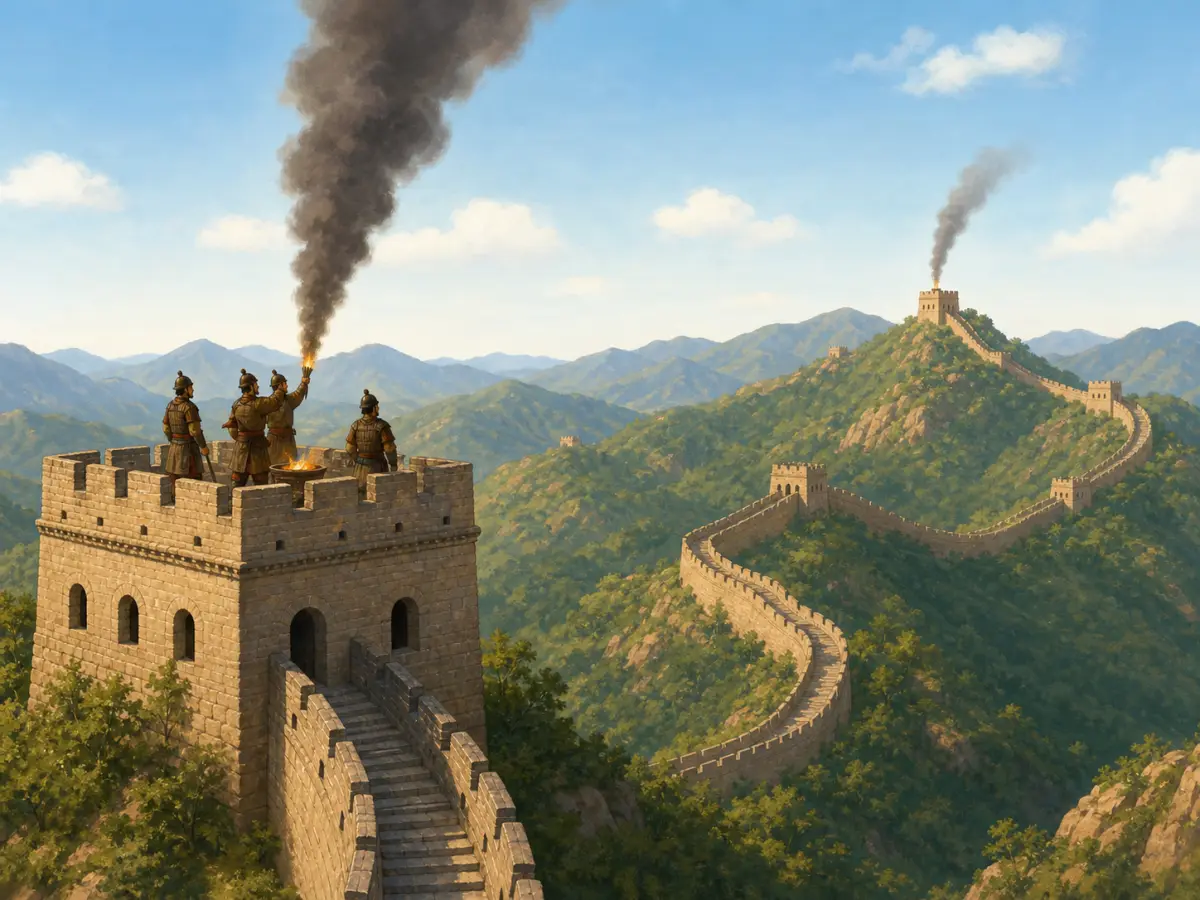
This is an imagined beacon relay. Real signals and speed varied.
墙自己看不见危险。士兵、道路、关口和一座座能互相看见的烽燧,才让防线工作。
守军可以在白天用烟和旗,夜里用火。有时还用鼓或炮声。每一种信号只能告诉别人简单的消息。
如果下雨、柴草太湿、风沙挡住视线,下一站可能看不到。那时还要有人骑马送信。烽火很快,却不是永远不会失败的古代电话。
A wall cannot see danger. Soldiers, roads, gates, and beacon stations within sight of one another made the system work.
Guards could use smoke or flags by day and fire at night. Some systems also used drums or cannon blasts. Each signal carried only a short, agreed message.
Rain could soak the fuel, and dust could block the view. The next station might miss the signal, so a rider might carry a written warning. Beacons could be fast, but they were not an ancient telephone that always worked.
Page 4
关门也会打开
A Gate Could Open Too
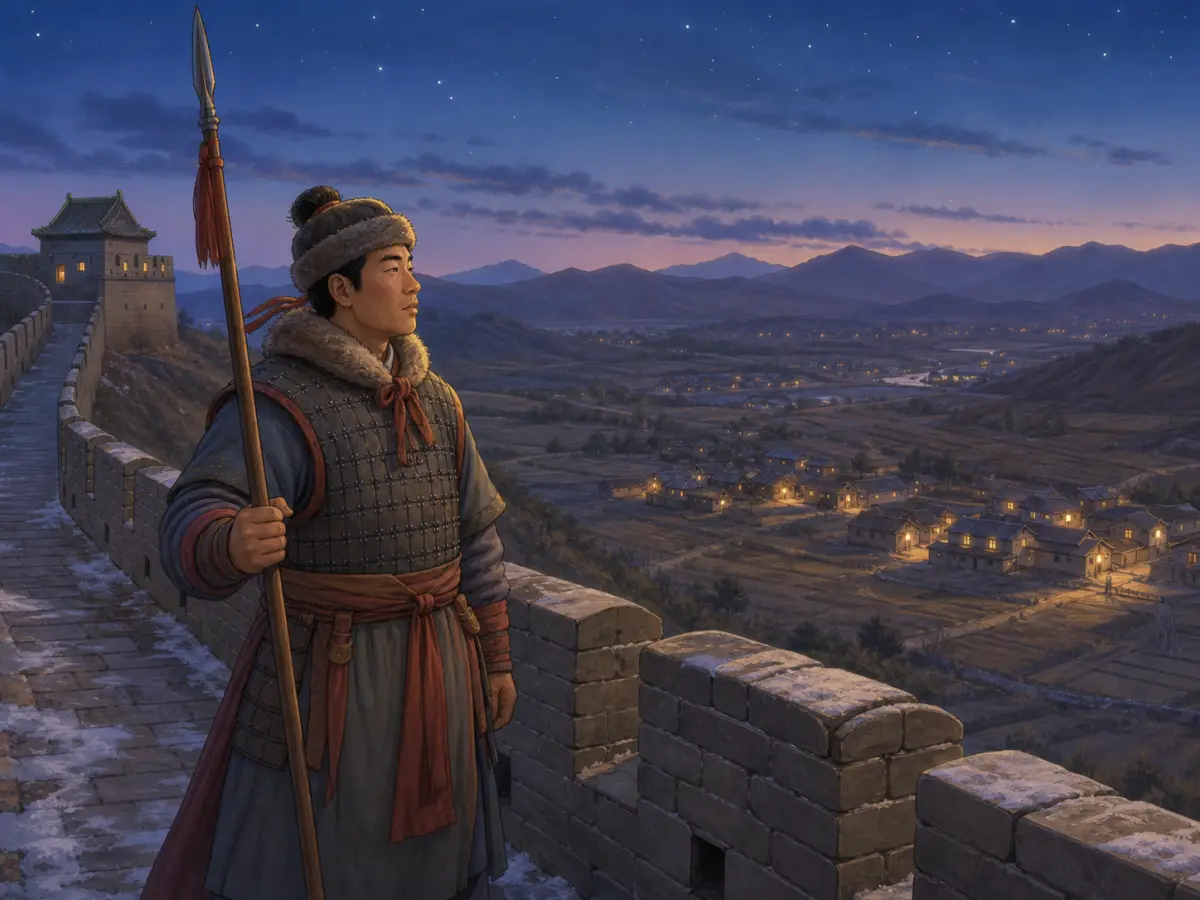
This guard and village are imagined, not a real patrol.
长城用来防御,可以让军队慢下来,把道路集中到有人看守的关口。但是军队也可能攻破、绕开,或找到没人守的地方。
关门也会打开。和平时期,边境市场交换马、牲畜、粮食、布和生活用品。商人、使者、士兵和搬家的人都会经过。
墙边不只有战斗,也有家庭、农民、牧民和商贩。不同人群会冲突,也会一起生活和交换食物、语言与技术。
The Wall served defense. It could slow an army and move travelers toward guarded gates. But armies sometimes broke through, went around, or found a section without enough guards.
Gates could open too. In peaceful times, border markets traded horses, animals, grain, cloth, and everyday goods. Merchants, messengers, soldiers, and families moved through.
Frontier life included families, farmers, herders, and traders as well as battles. Different communities fought, lived together, and shared food, words, and skills.
工程和人的代价
Engineering and Human Cost
长城显示了惊人的测量、选址和建造能力,也需要很多士兵和劳役人员搬土、夯筑和运送食物。历史很少留下普通工人的姓名。
孟姜女哭倒长城是一个后来长大的传说,不是能证明的秦代事件。可是她的眼泪记住了一个问题:宏伟工程是谁用双手建成的?谁离开家?谁承担危险?
我们可以同时赞叹长城,也记住普通人的代价。
The Great Wall shows astonishing skill in measuring land, choosing sites, and building. It also required soldiers and laborers to move earth, pound walls, and carry supplies. History rarely saved an ordinary worker's name.
Meng Jiangnu crying down the Wall is a legend that grew later, not a proven Qin event. Her tears remember a question: Whose hands built a great project? Who left home? Who faced the danger?
We can admire the Great Wall and remember the workers' cost at the same time.
长城:许多时代,许多边疆
The Great Wall: Many Times, Many Frontiers
Page 1
不是一条完整石龙
Not One Unbroken Stone Dragon
This imagined Ming-style Wall near Beijing does not represent every place or period.
北京附近的砖墙和敌楼太有名,让人以为长城到处都这样。甘肃戈壁里的残土墙、壕沟、烽燧和关堡却也属于长城。
长城不是一条连续墙,也不是一个朝代一次建完。2012年官方调查把历代墙体、壕堑等线性遗存合计为21,196.18千米,还记录烽燧、关堡等设施。这个总数不表示有人能沿一条完整墙走完。
肉眼也不能从月球看见长城。即使在较低地球轨道,它通常也很难分辨,因为窄而且颜色接近地面。长城不需要太空传说来证明伟大。
Brick walls and towers near Beijing are so famous that many people imagine the entire Great Wall that way. Yet a worn earthen ridge, trench, beacon mound, pass, or fort in the Gansu desert also belongs to its history.
The Great Wall is not one continuous structure, and one dynasty did not build it at once. A 2012 official survey counted 21,196.18 kilometers - 13,170 miles - of recognized walls, trenches, and other linear remains from many periods, plus related stations, passes, and forts. The total is not one complete path anyone can walk.
The Wall is not visible to unaided eyes from the Moon. It is usually hard to distinguish even from low Earth orbit because it is narrow and similar in color to the land. The Great Wall does not need a space myth to be extraordinary.
Page 2
战国、秦与不同方向的墙
Warring States, Qin, and Walls Facing Many Ways
This modern masonry scene looks later. It does not reconstruct Qin building.
战国时期,楚、齐、魏、赵、燕、秦等国修过各自的墙。方向不同,彼此不连;有的防北方骑马人群,有的防邻国。最早的墙不是一道简单的“农民对游牧人”边界。
公元前221年秦始皇统一后,拆除一些内地旧墙,在北方利用、修整和连接秦、赵、燕部分防线,也建新段。秦常用当地泥土夯筑,路线也不同于明长城。
士兵和征发劳工要挖土、夯实、搬运,还要在边地得到粮食和工具。历史保存皇帝将军的名字,却很少记住普通修墙人。
During the Warring States period, Chu, Qi, Wei, Zhao, Yan, Qin, and other states built walls. They faced different directions and did not join into one line. Some guarded against northern riders; others defended one state from another. The earliest walls were not a simple border between farmers and nomads.
After unification in 221 BCE, the First Emperor ordered some internal walls removed. In the north, the Qin government reused and repaired parts of older Qin, Zhao, and Yan lines and built new sections. Qin builders often rammed local earth, and their routes did not match the Ming Wall.
Soldiers and drafted laborers dug, pounded, and carried materials while supplies had to reach distant frontiers. Histories saved emperors' and generals' names far more often than workers' lives.
Page 3
汉代向西,明代上山
Han Defenses West, Ming Walls on the Mountains
汉代防线向西延伸到河西走廊和戈壁,帮助守卫道路、屯田、传警和管理往来。缺少石料的地方用夯土、砂砾、芦苇和红柳。它不像北京砖墙,却同样属于长城史。
北魏、北齐、隋、金等政权后来也修建或使用类似防线。不是一个固定民族永远在墙内、另一个永远在墙外;王朝、人群称呼和政治关系一直改变。
明代从1368到1644年,又大规模加强北方防务。在关口和北京附近山地,砖石墙、敌楼、城堡和多道防线出现。八达岭、慕田峪主要展示这层保存较好的明长城。
Han frontier systems extended west through the Hexi Corridor and into desert country. They helped guard routes, support military farms, send warnings, and manage movement. Where stone was scarce, builders used packed earth, gravel, reeds, and red willow. The remains look unlike Beijing brickwork but belong to the same history.
Northern Wei, Northern Qi, Sui, Jin, and other governments later built or reused frontier defenses. One fixed people did not remain forever “inside” while another remained “outside.” Dynasties, group names, and political relationships kept changing.
From 1368 to 1644, the Ming again built on a large scale. Brick and stone strengthened mountain passes and areas near Beijing, with towers, forts, and several defensive lines. Badaling and Mutianyu mainly display this well-preserved Ming layer.
Page 4
烽火能说多少话?
How Much Could a Beacon Say?
This imagined beacon relay cannot show the signals, fuel, or speed of every system.
墙不能自己看见危险。守军、道路、关口、城堡和能互相望见的烽燧让防线运转。白天可以用烟和旗,夜里用火,不同时代还用鼓或炮声。
信号只能传预先约定的短消息,例如发现敌情和大概规模。“狼烟”不表示每处都烧狼粪。各地燃料和规则不同。
大雨、湿柴、风沙和漏接都会让信号失败,守军还要骑马送文书。真实速度看能见度、距离和人员,不能保证几小时从任何边境直达首都。
A wall cannot see danger. Guards, roads, passes, forts, and beacon stations within sight of one another made the defense work. Smoke and flags could signal by day, fire by night, while some periods also used drums or cannon blasts.
Signals carried short, prearranged messages such as a warning and perhaps the rough size of a threat. The term “wolf smoke” does not prove that every station burned wolf dung. Fuel and rules varied.
Rain, wet fuel, dust, and missed relays could break the chain, so riders carried written messages too. Speed depended on sightlines, distance, and staffed stations. No system guaranteed news from every border point to the capital within hours.
Page 5
战争旁边也有市场
Markets Beside the Battlements
This imagined guard and valley village do not reconstruct a real patrol.
长城可以减慢骑兵、把出入口集中到关口、给守军准备时间,却不是密封盒子。军队能攻破、绕过,防线也会因缺人少粮失去作用。
关口也会开放。和平或议和时期,边口市场交换马、牲畜、粮食、布和日用品。使者、商人、士兵和迁居者来往。战争、贸易、结盟和移民会在同一边地发生。
两边不是永不相见的世界。军户、农民、牧民、商贩和家庭曾经冲突,也一起生活,交换食物、语言和技术。
The Wall could slow mounted forces, move crossings toward guarded gates, and buy preparation time. It was never a sealed box. Armies broke through, went around, or found lines weakened by too few soldiers and supplies.
Gates opened as well as closed. During peace agreements, border markets traded horses, livestock, grain, cloth, and daily goods. Envoys, merchants, soldiers, and migrants passed through. War, trade, alliance, and migration could share the same frontier.
The two sides were not worlds that never met. Military families, farmers, herders, traders, and children fought, lived together, and exchanged food, language, and skills.
谁的伟大,谁的代价?
Whose Achievement, and Whose Cost?
长城展示测量、选址、夯筑和组织能力,也留下劳役与死亡的记忆。孟姜女哭倒秦长城、找到丈夫遗骨不是可查证事件。这个传说从更早的哭夫故事经过几百年变化,才和秦始皇、长城连起来。
传说不是事实,却能保存人对真实经历的感受。她的眼泪问:谁搬土?谁离开家庭?谁承担风险?欣赏工程和记住工人代价并不矛盾。
长城不是切开历史的石龙,而是一部由土、砖、烽火、关门和人群往来写成的边疆史。
The Great Wall displays remarkable surveying, site choice, building, and organization. It also carries memories of forced labor and death. Meng Jiangnu's tears bringing down a Qin wall and uncovering her husband's bones are not a documented event. The legend grew from an older mourning-wife story and became attached to the First Emperor and the Wall centuries later.
A legend is not a fact, but it can preserve feelings about real experience. Her tears ask who carried the earth, left family, and faced danger. Admiring the engineering and remembering workers' cost are not opposites.
The Great Wall is not a stone dragon cutting history in two. It is frontier history written in earth, brick, warning fires, gates, and human movement.
长城不是一堵墙:读懂两千年的边疆
The Great Wall Is Not One Wall: Reading Two Thousand Years of Frontier History
Page 1
哪一个才是长城?
Which One Is the Great Wall?
A modern imagined Ming-style Wall near Beijing; brick walls and towers do not represent every place or period.
一位游客站在北京附近的山脊上,眼前是高大的砖墙、垛口和一座座敌楼。这个画面太有名了,以至于很多人以为长城从东到西都是这个样子。可是,在甘肃的戈壁里,一道被风吹残的土墙也可能是长城;有些地方甚至只剩壕沟、烽燧或关堡。
所以,“长城”不是一条从头到尾连续的墙,也不是一个朝代一次修完的建筑。它是许多政权在不同年代修建、使用、废弃又改造的边疆防御系统。2012年的官方调查把历代认定的墙体、壕堑等线性遗存合计为21,196.18千米,同时还登记了烽燧、关堡等相关设施。这个数字并不表示有人能沿着一条完整城墙走完这么远。
还有一个著名说法也不是真的:肉眼不能从月球看见长城。即使在较低的地球轨道上,它也通常很难用肉眼分辨,因为墙体很窄,颜色又接近周围地面。长城的伟大不需要靠太空传说证明。
A visitor stands on a mountain ridge near Beijing. Ahead are tall brick walls, battlements, and watchtowers. The view is so famous that many people imagine the entire Great Wall looking this way. But a wind-worn ridge of earth in the Gansu desert can also be part of the Great Wall. In other places, only a ditch, beacon mound, fortress, or pass remains.
“The Great Wall” is not one unbroken wall, and one dynasty did not build it all at once. It is a large family of frontier systems that different governments built, used, abandoned, and changed. In 2012, an official survey gave a combined length of 13,170 miles (21,196.18 kilometers) for recognized walls, trenches, and other linear remains from many periods. It also recorded beacon stations, passes, forts, and related structures as parts of Great Wall heritage. The number does not mean that anyone can walk that far along one complete wall.
One famous claim is also false: people cannot see the Great Wall with their bare eyes from the Moon. It is usually difficult to spot even from low Earth orbit because it is narrow and close in color to the land around it. The Wall does not need a space myth to be extraordinary.
Page 2
第一层:战国的墙与秦的北方防线
First Layer: Warring States Walls and the Qin Northern Line
A modern imagined masonry work site that looks later than the Qin; it is not a reconstruction of Qin construction.
两千三百多年前,中国还没有统一。战国时期的楚、齐、魏、赵、燕、秦等国修建过各自的墙。这些墙方向不同,彼此并不相连;有的防备北方骑马人群,有的却是为了防邻近诸侯国。最早的长城不是一道清楚的“农民对游牧人”分界线,而是许多国家争夺土地、道路和安全的结果。
公元前221年,秦始皇统一六国。他下令拆除一些失去作用的内地城墙,又利用、修整和连接秦、赵、燕北部的部分旧防线,并修建新段。这样出现了横跨帝国北方的庞大防御工程。可是秦代多用当地泥土夯筑,路线也和后来的明长城不完全相同;今天游客常走的砖石长城,并不是秦始皇脚下的原墙。
修墙也不是按下一道命令就完成。士兵和被征发的劳役人员要挖土、夯实、搬运材料,还要在遥远边地取得粮食和工具。史书留下皇帝与将军的名字,却很少告诉我们一个普通修墙人哪天受伤、想不想家,或者最后去了哪里。
More than 2,300 years ago, China was not yet one empire. During the Warring States period, states including Chu, Qi, Wei, Zhao, Yan, and Qin built walls of their own. The walls pointed in different directions and did not form one line. Some faced groups of riders to the north, while others defended one state from another. The earliest walls were not a simple border between “farmers” and “nomads.” They grew out of many struggles over land, roads, and safety.
In 221 BCE, the First Emperor of Qin united the rival states. He ordered some walls inside the new empire removed. Along the northern frontier, his government reused, repaired, and joined parts of older Qin, Zhao, and Yan lines and built new sections. This created an enormous defense project across the north. But Qin builders mostly rammed local earth into hard layers, and their route did not exactly match the later Ming Wall. The brick Wall tourists walk on today is not the same surface Qin soldiers stood on.
Building did not happen just because an emperor gave an order. Soldiers and drafted laborers dug soil, pounded it firm, carried supplies, and somehow had to obtain food and tools in distant places. Histories saved the names of emperors and generals. They rarely tell us when one ordinary worker was hurt, missed home, or disappeared from the record.
Page 3
第二层:汉代向西,明代重新筑起
Second Layer: Han Routes West and Ming Walls on the Mountains
汉代的防线向西延伸到河西走廊和更远的戈壁地区,与守卫交通、屯田、传递军情和管理往来联系在一起。那里缺少大块石料,工匠便就地取材,用夯土、砂砾,有时夹入芦苇和红柳。远远看去,它不像北京山上的城墙,却同样属于长城历史。
秦汉以后,北魏、北齐、隋、金等不同政权也修过或利用过类似防线。修长城的并不只是一个朝代,也不能简单说成一个固定族群永远在墙内、另一个固定族群永远在墙外。王朝版图、人群称呼和政治关系一直在改变。
到了明代,也就是1368年至1644年,北方防务再次推动大规模建设。明军在重要关口和北京附近的山地使用砖石加固墙体,修建敌楼、城堡与多重防线。今天八达岭、慕田峪等著名景区主要展示的正是明长城。我们熟悉的“石头巨龙”,其实只是长城两千年历史中最醒目、保存较好的一层。
The Han dynasty extended frontier defenses west through the Hexi Corridor and into desert country. The system helped guard travel routes, support military farms, carry warnings, and control movement. Where large stone was scarce, builders used what they had: packed earth and gravel, sometimes strengthened with layers of reeds or red willow. These remains may look nothing like the Wall near Beijing, but they belong to the same long history.
After the Qin and Han, governments including the Northern Wei, Northern Qi, Sui, and Jin also built or reused long frontier defenses. The Great Wall was not the work of only one dynasty. Nor did one unchanging people always live “inside” while another unchanging people always lived “outside.” Kingdoms expanded and fell, group names changed, and political relationships shifted again and again.
During the Ming dynasty, from 1368 to 1644, northern defense led to another age of major construction. Ming forces strengthened important mountain passes and areas near Beijing with brick and stone. They built watchtowers, forts, and walls in several lines. Famous visitor sites such as Badaling and Mutianyu mainly show Ming construction. The “stone dragon” we know best is one dramatic, well-preserved layer of a much longer story.
Page 4
一条信号怎样翻过山头
How Did a Warning Cross a Mountain?
An imagined beacon relay; signals, fuel, station positions, and speed varied across periods and conditions.
墙本身不能看见危险,也不能追赶任何人。真正让防线运转的是守军、关口、城堡、道路和一座座可以互相望见的烽燧。士兵观察到情况后,会按照当时的规定发出信号;白天可以用烟、旗帜等,夜间可以用火,不同朝代还使用鼓声或炮声表示不同等级的警报。
这不是随便点一堆“狼粪”,烟就一定笔直冲天。史料显示,各地燃料和信号办法并不一样,“狼烟”也不能简单等同于烧狼粪。更重要的是,烽火只能传递预先约定的简短信息,例如发现敌情和大概规模。遇到大雨、柴草受潮、风沙遮住视线,或下一座烽燧没有回应时,守军还要派人骑马送文书。
图中的黑烟与接力场面是现代想象,不是一场有日期的明代警报。真实速度取决于能见度、台站距离、人员是否在岗以及信号路线。烽火能让警报快速传到附近军区,但不能保证“几小时从任何边境直达首都”。
A wall cannot see danger or chase anyone. Soldiers, gates, forts, roads, and beacon stations made the system work. When guards spotted trouble, they followed rules for sending signals. Smoke or flags could be used by day and fire by night. In different periods, drums or cannon blasts also helped show the kind or size of a threat.
This was not as simple as burning a pile of “wolf dung” and watching a perfectly straight cloud rise. Fuels and signal rules varied, and the old term “wolf smoke” does not prove that every beacon burned wolf dung. More important, a beacon could send only a short, prearranged message, such as “danger spotted” and perhaps its rough size. If rain soaked the fuel, a dust storm blocked the view, or the next station did not answer, a rider had to carry a written warning instead.
The black smoke and tower-to-tower relay in our picture are a modern reconstruction, not a record of one particular Ming alarm. Real speed depended on visibility, distance, watchful guards, and the route. Beacons could warn a nearby command quickly. They could not promise to carry news from any frontier point to the capital in a few hours.
Page 5
墙边既有冲突,也有市场
A Border with Battles - and Markets
A modern imagined guard and valley settlement; the armor, spear, night, and village do not reconstruct a real patrol.
长城的确用于防御。它可以让骑兵难以突然穿过某些道路,把出入口集中到容易监视的关口,也给守军争取准备时间。但它不是一只密封的盒子:军队可能攻破关口、绕过没有墙的地方,防线也可能因为缺兵少粮而失去作用。
关口能关闭,也能打开。和平或议和时期,边口会有市场,不同人群交换马匹、牲畜、粮食、布匹和生活用品;使者、商人、士兵和迁居者也从通道往来。战争、贸易、赏赐、结盟和移民常在同一片边地先后发生。墙两边不是两种从不相见的世界,而是一片既紧张又互相需要的地区。
图中守军的身后亮着村庄的灯。这是象征性的现代画面,却提醒我们:长城边上不仅有将军和战斗,也有军户、农民、牧民、商贩与家人。许多不同族群的人曾在这里冲突,也曾一起生活和交换技术、语言与食物。
The Wall did serve defense. It could slow mounted forces at important paths, move crossings toward guarded gates, and buy time for soldiers to prepare. But it was not a sealed box. Armies sometimes broke through a pass, went around a section, or found a weak line with too few soldiers and supplies.
Gates could close, and they could also open. During peaceful agreements, border markets let different communities trade horses, livestock, grain, cloth, and everyday goods. Envoys, merchants, soldiers, and migrants also moved through the passes. War, trade, gifts, alliances, and migration could all take place along the same frontier. The two sides of the Wall were not separate worlds that never met. Together they formed a tense frontier where people also depended on one another.
Village lights glow behind the guard in our picture. The scene is symbolic, but it reminds us that frontier life included military families, farmers, herders, traders, and children as well as generals and battles. People from many communities fought there, lived there, and exchanged food, words, and skills.
Page 6
谁的伟大,谁的代价?
Whose Achievement, and Whose Cost?
古代长城显示了惊人的测量、选址、夯筑和组织能力,也留下了劳役与死亡的记忆。孟姜女哭长城就是最有名的传说之一。她哭倒秦长城、找到丈夫遗骨的情节不是可以查证的秦代事件;这个故事由更早的“杞梁妻哭夫”传说经过许多世纪变化,后来才和秦始皇及长城连在一起。
传说不等于事实,却能保存人们对事实的感受。孟姜女的眼泪让一座宏伟工程出现了另一个问题:当皇帝命令修筑边防时,谁在搬土,谁离开家庭,谁承担风险?欣赏长城的工程成就,与记住普通人的代价,并不矛盾。
The Great Wall shows astonishing skill in surveying, choosing terrain, building with local materials, and organizing work. It also carries memories of forced labor and death. The legend of Meng Jiangnu is the most famous example. Her tears bringing down a Qin wall and revealing her husband’s bones are not a recorded event from the Qin dynasty. The tale grew from a much older story about a mourning wife and became attached to the First Emperor and the Great Wall centuries later.
A legend is not the same as a fact, but it can preserve how people felt about real experience. Meng Jiangnu’s tears ask a question that the grand structure might hide: When a king or emperor orders a frontier wall, who carries the earth, who leaves a family behind, and who faces the danger? We can admire the engineering and remember the workers’ cost at the same time.
再看那条“石龙”
Look at the “Stone Dragon” Again
今天再看山脊上的砖墙,不妨也想象戈壁中的土垄、消失的木料、开放过的市场和早已听不见的多种语言。长城不是一条把历史切成两半的石龙,而是一部用土、砖、烽火、关门和人群往来共同写成的边疆史。
When you next picture the brick Wall on a green ridge, add other images too: a low earthen line in the desert, wood that vanished long ago, a market beside an open gate, and many languages that can no longer be heard. The Great Wall is not a stone dragon cutting history in two. It is a frontier history written in earth, brick, warning fires, gates, and human movement.