古代铠甲是怎样拼起来的?
How Was Ancient Armor Put Together?
Page 1
三条线索
Three Clues
考古工作室里有三样东西:一小片旧皮革、一团锈在一起的铁片,还有一个穿着铠甲的陶俑。哪一个能告诉我们古代士兵穿什么?
三个都重要,却没有一个能给出完整答案。皮革和布会腐烂,铁会生锈,连接甲片的绳子也会消失。陶俑能保存外形,却不一定告诉我们甲片是皮还是铁。
研究铠甲像拼一幅缺了很多块的图。现代图片画得很清楚,不代表历史也同样清楚。
Three objects sit on an archaeologist's table: a scrap of old leather, a lump of iron plates rusted together, and a clay soldier wearing armor. Which one can tell us what an ancient soldier wore?
All three matter, but none gives the whole answer. Leather and cloth decay. Iron rusts. The cords between plates may disappear. A clay figure preserves a shape, but it may not tell us whether the real plates were leather or iron.
Studying armor is like building a puzzle with many missing pieces. A modern picture may look clear even when the history is not.
Page 2
皮、铜和铁一起存在
Leather, Bronze, and Iron Overlapped
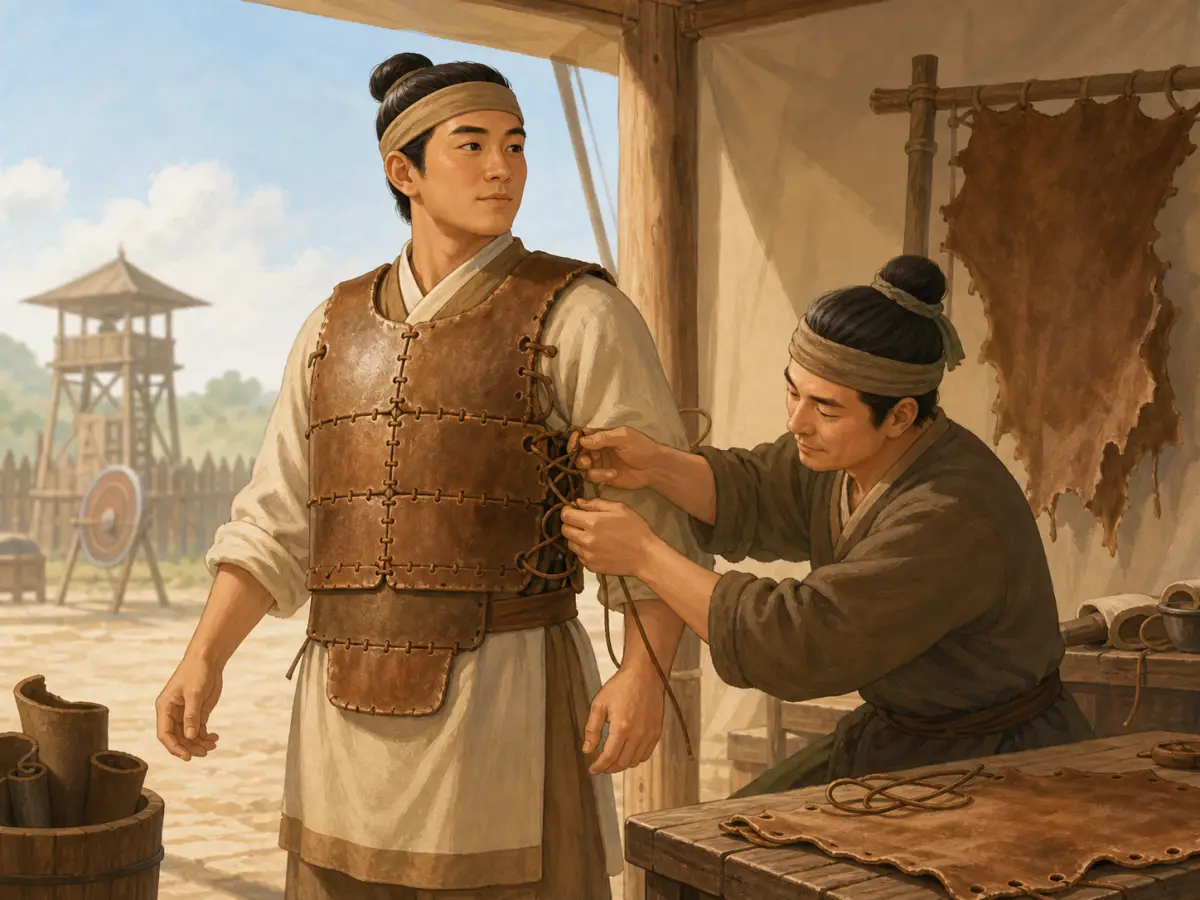
This imagined picture shows cutting, piercing, and joining leather. It does not reconstruct an ancient workshop.
有些图把铠甲排成升级队伍:先是兽皮,再是青铜,然后铁和钢。真正历史没有这么整齐。
古代有皮甲片、铜甲片和铁甲片。铁甲出现以后,皮革和布也没有马上消失。不同地方、不同士兵和身体不同部位,会选择不同材料。
工匠要考虑重量、活动、天气、制作时间和修理。最新、最硬的材料,不一定适合每一个人。
Some pictures arrange armor like game upgrades: first hide, then bronze, then iron and steel. Real history was not so tidy.
Ancient armor used leather, bronze, and iron plates. Leather and cloth did not disappear when iron appeared. Different places, soldiers, and parts of the body could use different materials.
Armor makers thought about weight, movement, weather, time, and repair. The newest or hardest material was not always right for every job.
Page 3
小片也能保护身体
Small Plates Can Protect a Body
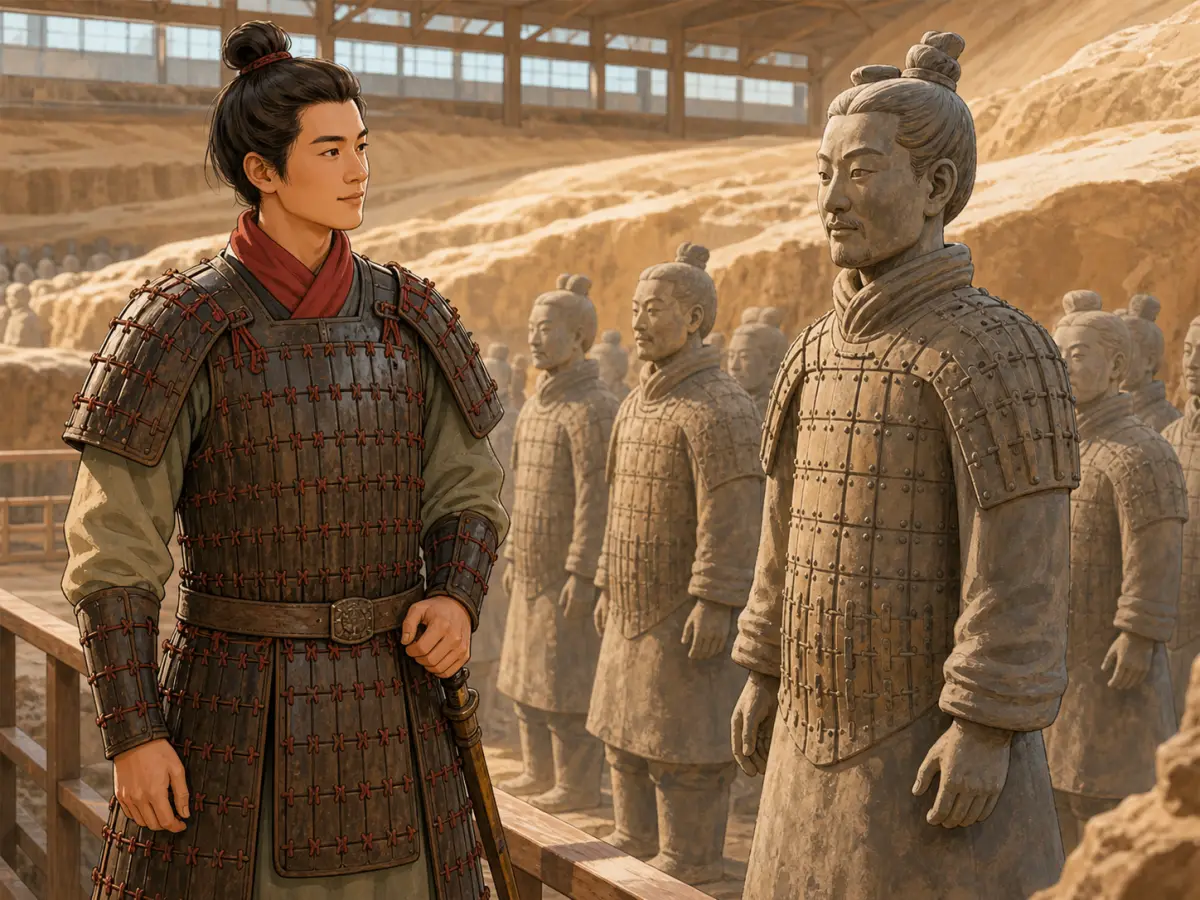
A modern person beside clay warriors only shows how someone might imagine real armor from sculpture.
很多中国古代铠甲不是一整块硬壳。工匠在小甲片上打孔,再用绳带把一排排甲片连起来。有些甲片像屋瓦或鱼鳞一样重叠。
小片能在身体弯曲时移动,坏了一部分也可能只换那一块。不过,打孔、涂漆和穿绳都很费时间,绳子还会磨坏。
兵马俑把甲片形状做得很细,却是陶土。它们不能证明所有秦兵都穿同一种材料和样式。
Much ancient Chinese armor was not one hard shell. Makers punched holes in small plates and tied rows together with cords. Some plates overlapped like roof tiles or fish scales.
Small plates could shift when the body bent. A damaged part might be replaced without remaking the whole suit. But punching, painting, and lacing took time, and cords wore out.
The Terracotta Warriors show armor shapes in great detail, but their armor is clay. They cannot prove that every Qin soldier wore the same material or design.
Page 4
从锈块找回铠甲
Finding Armor Inside a Lump of Rust
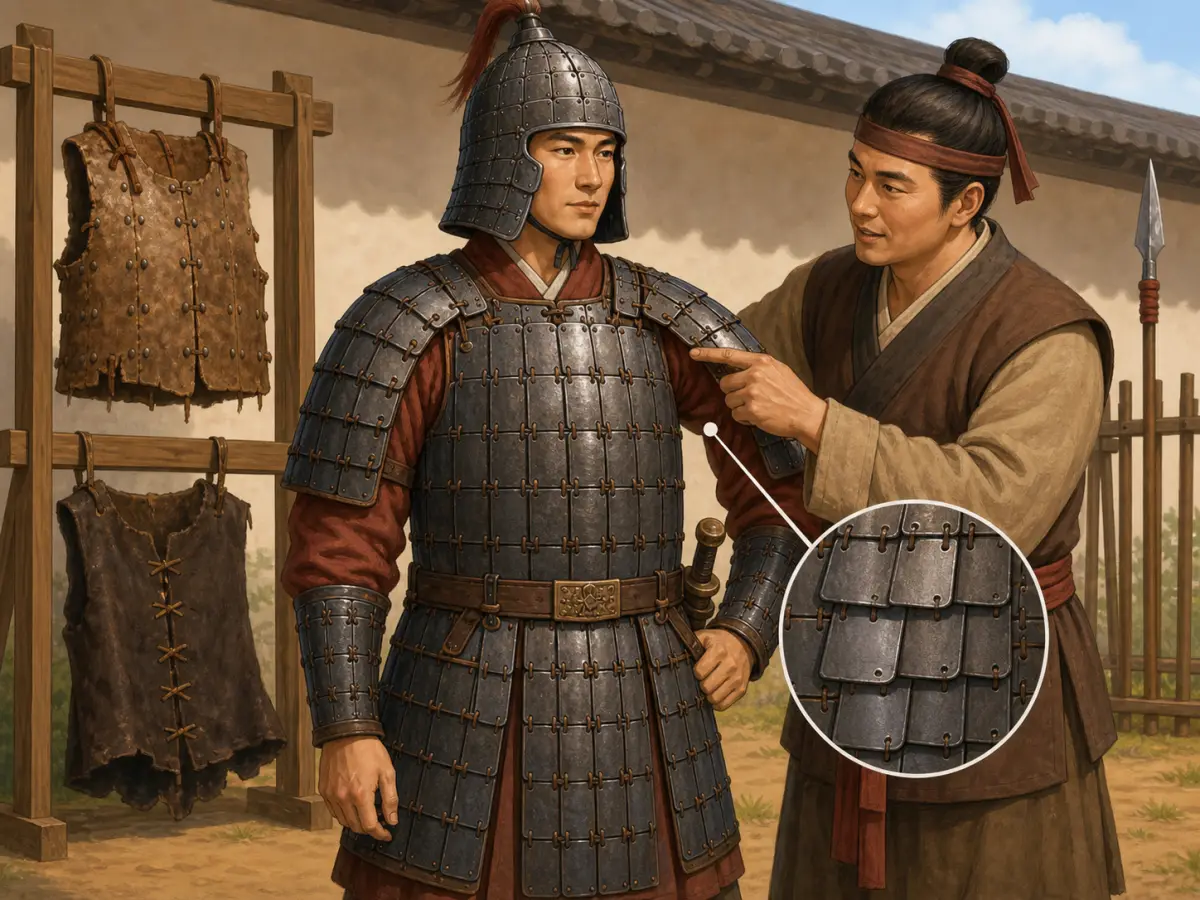
This modern composite shows laced iron plates. It does not prove that all Han troops wore this helmet and red plume.
汉代墓里,一件铁甲已经锈成一团。修复者慢慢整理,发现它由将近三千片铁甲片组成。别的墓还留下上万片残片。
甲片上的孔、形状和绳子痕迹,帮助修复者找出它们怎样连接。不同结构说明,同一时代也没有一套所有人都穿的制服。
现代图里的护面头盔和红缨是设计者加的,不能变成汉代全军的历史事实。
In one Han tomb, an iron suit had rusted into a solid lump. Conservators slowly separated it and found nearly three thousand plates. Another tomb held more than ten thousand armor fragments.
Holes, shapes, and traces of cord helped researchers work out how the pieces joined. Different structures show that one period did not have a single uniform worn by everyone.
The face-covering helmet and red plume in the modern picture are design choices. They cannot become facts about the whole Han army.
像修复者一样提问
Ask Questions Like a Conservator
看见古代铠甲,可以问:这是出土实物、雕塑、文字,还是现代复原?它用什么材料?甲片怎样连接?保护身体哪里?属于什么时间、地方和使用者?
古代铠甲没有从皮到铜、铁、钢一路升级。真正的历史,是工匠用手边材料调整结构,也是考古学家从朽皮、锈片、孔洞和雕塑中一点点找回答案。
When you see ancient armor, ask: Is it an excavated object, a sculpture, a written description, or a modern reconstruction? What is it made from? How are the plates joined? What does it cover? When, where, and by whom was it used?
Ancient armor did not level up from hide to bronze to iron to steel. Its real history is the story of makers adjusting structures with available materials - and archaeologists recovering answers from leather scraps, rusted plates, holes, and sculpture.
一片甲能告诉我们什么?
What Can One Armor Plate Tell Us?
Page 1
考古桌上的三件东西
Three Objects on the Archaeologist's Table
桌上有一片发黑的皮革、一团锈结铁片和一个穿甲陶俑。三件都能提供线索,却没有一件能单独给出完整答案。
皮革、布和绳带容易腐烂,铁会锈成硬块。陶俑、壁画和文字能保存外形,却未必说明甲片材料。研究铠甲像拼缺块的图,必须先分清每种证据。
现代复原可以画得非常清楚,但清楚的画面不能替代清楚的证据。
A blackened scrap of leather, a lump of iron plates rusted together, and an armored clay figure sit on a table. Each offers clues. None can provide a complete suit by itself.
Leather, cloth, and cords decay. Iron corrodes into hard masses. Figures, paintings, and words can preserve a shape without revealing the material. Studying armor is a puzzle with missing pieces, so every clue must first be identified.
A modern reconstruction can look perfectly clear. A clear picture is not the same as clear evidence.
Page 2
材料没有排队退出历史
Materials Did Not Leave History in a Line
This modern scene imagines leather cutting and joining. It does not reconstruct a Shang or Zhou workshop.
考古没有支持“兽皮、青铜、铁、钢”整齐升级的时间线。商代有彩绘皮甲片,西周有铜片,春秋战国有涂漆皮甲;铁片出现以后,皮革、织物和金属仍继续并存。
工匠要平衡原料、工时、重量、活动、潮湿和维修。硬皮能做成较轻的甲片;金属耐切割,却需要采矿、冶炼和锻打,也会生锈。十二至十三世纪云南大理国仍有以涂漆硬皮为主、同时使用铜合金和铁的铠甲。
旧材料没有因为新材料出现就自动消失。图片能表现裁切、打孔和连接,完整胸衣、工具与营地却是想象。
Archaeology does not support a neat hide-bronze-iron-steel upgrade line. Painted leather plates appear in Shang contexts, bronze plates in the Western Zhou, and lacquered leather suits in the Eastern Zhou. After iron plates appeared, leather, textiles, and metals continued side by side.
Makers balanced materials, labor, weight, movement, moisture, and repair. Hardened leather could make lighter plates. Metal resisted cutting but required mining, smelting, and forging, and it rusted. A twelfth- or thirteenth-century suit from the Dali Kingdom in Yunnan still combined lacquered hard leather with copper alloy and iron.
An older material did not vanish when a new one arrived. The illustration can show cutting and joining, but its complete vest, tools, and camp are imagined.
Page 3
小甲片的结构
Building with Small Plates
许多古代中国铠甲由打孔小片组成。甲片彼此编缀成排的结构常称札甲;像屋瓦或鱼鳞重叠、固定在柔软衬底上的常称鳞甲。古代名称和现代分类不总能完全对应。
孔洞、折痕和绳迹能告诉修复者哪边朝上、怎样重叠、肩腰是否使用不同形状。小片可以在身体弯曲时相对移动,坏了也可能局部替换。
代价是劳动:钻孔、涂漆和穿绳都耗时,绳带还是最容易磨损的部分之一。
Much ancient Chinese armor used small pierced plates. Plates laced directly into rows are often called lamellar armor. Overlapping plates fastened to a softer backing are often called scale armor. Ancient terms and modern categories do not always match perfectly.
Holes, creases, and cord marks help conservators decide which end faced up, how plates overlapped, and whether shoulders and waists needed different shapes. Small pieces could shift as the body bent, and damaged sections might be replaced.
The cost was labor. Punching holes, adding lacquer, and threading cords took time, while laces could wear out.
Page 4
兵马俑保存外形
The Terracotta Army Preserves Shapes
A modern costumed figure beside clay warriors only suggests reconstructing equipment from sculpture.
兵马俑细致表现领口、腰带和甲片排列。步兵、骑兵、军官和无甲人物的覆盖方式不同,这能帮助研究分工和结构,却不能证明所有秦兵装备一样。
陶俑的甲也是陶土。许多研究者根据战国皮甲实物和雕塑表面,把它们解释为涂漆皮甲形象;秦代已有铁器,真实军队可能使用多种材料。
秦陵另一个坑有石灰岩片和铜丝做的铠甲,太重太脆,可能是墓葬礼仪模型。它能说明结构,不表示士兵穿石甲上战场。
The Terracotta Army models collars, belts, and rows of plates in remarkable detail. Infantry, cavalry, officers, and unarmored figures show different coverage. These differences help researchers study military roles and armor structure, but they do not show one uniform for every Qin soldier.
The armor itself is clay. Comparing it with Warring States leather finds leads many researchers to see lacquered leather in the modeled suits. Yet iron already existed, and a real army may have used more than one material.
Another mausoleum pit held armor made from limestone plates and copper wire. Too heavy and fragile for battle, it was probably a funerary model. It reveals construction without showing soldiers fighting in stone.
Page 5
锈块里的三千片
Three Thousand Plates Inside the Rust
This modern iron lamellar suit includes a helmet and red plume that cannot represent all Han troops.
汉代铁甲越来越重要,却不表示此前没有铁、以后没有皮。西汉刘胜墓的一团锈铁,整理后发现接近三千片熟铁甲片。徐州另一座王陵的上万片残片,又能复原札甲和不同大小的鳞甲。
同一时期也有多种结构。“铁”和“钢”也不是简单先后两级。秦汉工匠已经使用熟铁、钢和不同铸铁,并把金属片、皮绳、漆和织物组合。
现代图里的整套甲、护面头盔和红缨可以解释编缀,却没有证据证明全军穿同一套。
Iron armor grew more important in the Han, but that does not mean iron had never appeared before or leather vanished later. A rusted mass from Liu Sheng's Western Han tomb became nearly three thousand wrought-iron plates after conservation. More than ten thousand fragments from another royal tomb near Xuzhou revealed lamellar and several scale structures.
One period held many designs. Iron and steel were not two simple steps either. Qin and Han makers already used wrought iron, steel, and forms of cast iron, sometimes combining metal plates, leather cords, lacquer, and cloth.
The complete suit, face-covering helmet, and red plume in the modern image explain lacing. They do not prove a whole army wore the same set.
找出升级图的陷阱
Find the Trap in the Upgrade Picture
把毛边皮衣、铜胸甲、铁甲和亮钢壳排成一列,很像电子游戏。图里的整块胸甲更像欧洲式轮廓,不能代表中国朝代顺序。
真正变化常在甲片大小、孔位、重叠方向、覆盖部位和连接材料中。地点、兵种和用途也很重要,同一时代的差异可能比两个朝代之间还大。
像修复者一样问:这是实物、图像、文字还是复原?材料和结构是什么?证据到哪里,猜测从哪里开始?
A row that moves from a fur-edged hide vest to bronze, iron, and shining steel looks like a video-game upgrade. The solid breastplates in that image are closer to European shapes and cannot represent a Chinese dynastic sequence.
Real changes often appear in plate size, holes, overlap, coverage, and lacing. Place, military role, and purpose matter too. Differences within one period may be greater than those between dynasties.
Ask like a conservator: Is this an object, image, text, or reconstruction? What are its material and structure? Where does evidence end and the best current guess begin?
一片甲,许多答案:中国古代铠甲怎样保护身体
One Armor Plate, Many Answers: Body Armor in Ancient China
Page 1
考古桌上的难题
A Puzzle on the Archaeologist's Table
想象考古工作室里摆着三样东西:一小片发黑的皮革、一团锈结的铁片,还有一个身穿铠甲的陶俑。哪一件最能告诉我们古代士兵穿什么?答案是:三件都重要,却没有一件能单独给出完整答案。
皮革和织物容易腐烂,铁会锈成硬块,绳带也常常消失。陶俑、壁画和文字比较容易让我们看见铠甲的外形,却未必告诉我们甲片究竟是皮、铜还是铁。研究古代铠甲就像拼一幅缺了许多块的图:先分清证据,再小心复原,不能把想象画得清楚,就当成历史也同样清楚。
Imagine three objects on a conservation table: a dark scrap of leather, a solid lump of rusted iron plates, and a clay soldier wearing carefully modeled armor. Which one tells us what ancient soldiers wore? All three matter, but none can give the complete answer alone.
Leather and cloth decay. Iron plates rust together, while the cords that joined them often disappear. Tomb figures, paintings, and written descriptions can preserve an armor's shape, but they may not tell us whether its plates were made of hide, bronze, or iron. Studying ancient armor is like assembling a picture with many pieces missing. We have to identify each kind of clue before attempting a reconstruction. A modern picture can look perfectly clear even when the history is not.
Page 2
材料不是一级一级换掉的
Materials Did Not Replace One Another in a Neat Order
This modern image shows cutting, piercing, and joining leather. Its vest, stitching, clothing, tools, and camp are not a Shang - Zhou reconstruction.
旧故事常把铠甲排成一列:先有兽皮,再有青铜,接着是铁,最后升级成钢。考古发现并不支持这样整齐的台阶。商代墓葬发现过彩绘皮质甲片,西周有铜甲片,春秋战国又有成套的涂漆皮甲;铁甲片逐渐出现以后,皮革、织物和金属仍会在不同地区、不同部队和不同部位继续使用。
为什么不把所有甲都换成“最新材料”?因为工匠要同时考虑原料、制作时间、重量、活动方式、潮湿和维修。硬皮经过整形和涂漆,可以做成轻便的甲片;金属更耐切割,却要采矿、冶炼和锻打,也可能生锈。十二至十三世纪云南大理国的一件实物铠甲,仍以涂了红黑漆的硬皮板为主体,并同时使用皮绳、铜合金和铁。这件晚期皮甲证明,旧材料不会因为铁器出现就自动退出历史。
第一幅图可以帮助我们看见“裁皮、打孔、连接”的动作,却不是商代工坊的复原图。画中的完整胸衣、缝法、衣服、工具和营地布置都属于现代想象,不能拿来证明商周士兵统一穿这种样式。
An old-fashioned story lines armor up like this: first animal hide, then bronze, then iron, and finally steel. Archaeology does not show such a tidy staircase. Painted leather armor plates have been found in Shang tombs, bronze plates are known from the Western Zhou, and complete suits of lacquered leather armor survive from the Spring and Autumn and Warring States periods. After iron plates appeared, leather, textiles, and metals continued to serve different regions, units, and parts of the body.
Why not replace every suit with the “newest” material? Armor makers had to balance raw materials, labor, weight, movement, weather, and repair. Shaped and lacquered hard leather could form relatively light plates. Metal resisted cutting well, but it required mining, smelting, and forging, and it could rust. A surviving suit from the Dali Kingdom in twelfth- or thirteenth-century Yunnan still used rigid leather panels coated with red and black lacquer, together with leather laces, copper alloy, and iron. This late leather armor proves that an older material did not vanish when iron became available.
The first illustration helps us picture the actions of cutting, piercing, and joining leather, but it is not a reconstruction of a Shang workshop. Its complete vest, stitching pattern, clothes, tools, and camp are modern inventions. It cannot prove that Shang or Zhou soldiers wore one standard design like this.
Page 3
小甲片怎样变成一件甲
How Small Plates Became a Suit
许多古代中国铠甲不是一整块硬壳,而是由打孔的小片连接起来。研究者常把甲片彼此横向、纵向编缀成排的结构称为“札甲”;另一类像屋瓦或鱼鳞那样重叠、固定在皮革或织物衬底上的结构,可称为“鳞甲”。古人使用的名称和现代研究分类不总是一一对应,所以看到“小片重叠”,不能马上断定只有一种做法。
甲片上的孔、折痕和绳迹非常重要。它们能帮助修复者判断哪一边朝上、相邻甲片怎样重叠、肩部与腰部是否需要不同形状。用许多小片的好处,是身体弯曲时,各排甲片还能相对移动,损坏后也可能只换一部分;代价则是钻孔、涂漆和编绳都很费工,绳带还是容易磨损的地方。
Much ancient Chinese armor was not one solid shell. It was built from small, perforated plates. Researchers often call armor made by lacing plates directly to one another in horizontal and vertical rows lamellar armor, or zhajia in Chinese. A related construction, often called scale armor, arranges overlapping plates like roof tiles or fish scales and fastens them to a leather or textile backing. Ancient names and modern categories do not always match perfectly, so the sight of overlapping plates does not prove that only one method was used.
Holes, creases, and traces of cord can be as valuable as the plates themselves. They help conservators work out which end pointed upward, how neighboring plates overlapped, and whether the shoulders and waist required different shapes. Small plates allowed rows to shift as the wearer bent and sometimes allowed a damaged section to be replaced. The cost was labor: punching holes, applying lacquer, and threading cords took time, and the cords themselves could wear out.
Page 4
兵马俑告诉我们外形,不直接告诉我们材料
The Terracotta Army Shows Shape, Not Material Directly
This image mixes a modern costumed figure with clay warriors. It suggests a reconstruction from sculpture, but it is not an archaeological record.
秦始皇陵的陶俑把三世纪前的衣领、腰带和甲片排列塑得很细。有些步兵俑的躯干和肩膀有甲,有些骑兵俑的防护较短,也有俑没有穿甲;军官形象的装饰和覆盖方式又不同。这些差异让我们研究军队分工和甲衣结构,却不能证明每个真实秦兵都得到同样装备。
陶俑的甲也是陶土塑出来的。根据战国涂漆皮甲实物和陶俑表面的表现,许多研究者把它们理解为涂漆皮甲的形象;但秦代已经有铁器,真实军队也可能使用不止一种材料。说“秦军主力一定都是皮甲”超出了陶俑能证明的范围。
秦始皇陵另一个坑还出土了用石灰岩片和铜丝编成的甲胄。它们制作精细,却太重、太脆,不适合直接上战场,更可能是陵墓中的礼仪模型。第二幅图把现代真人复原放进兵马俑坑,只能作为“根据陶俑想象真实铠甲”的示意,不能当作考古现场。
The Terracotta Army from the First Emperor's mausoleum models collars, belts, and armor patterns from the third century BCE in remarkable detail. Some infantry figures have protection over the torso and shoulders. Some cavalry figures wear shorter armor, other figures have no armor, and officer figures show different coverage and decoration. These differences help researchers study military roles and armor construction. They do not show that every living Qin soldier received the same equipment.
The armor on each figure is clay. Based on surviving lacquered leather armor from the Warring States period and the modeled surfaces, many scholars interpret the figures as representations of lacquered leather armor. Yet iron was already used in Qin times, and a real army could use more than one material. The figures cannot support the blanket claim that the Qin army's “main armor” was certainly leather.
Another pit at the mausoleum contained armor made from limestone plates joined with copper wire. The pieces are finely made but too heavy and fragile for ordinary combat, so they were probably ceremonial models for the tomb. The second illustration places a modern costumed person inside a Terracotta Army excavation. It can only suggest how someone might imagine armor from the figures; it is not an archaeological scene.
Page 5
汉代铁甲:从锈块读回三千片
Han Iron Armor: Reading Three Thousand Plates from a Rusted Lump
This modern composite can explain laced iron plates. It does not prove that Han troops shared this suit, face guard, or red plume.
铁甲在战国晚期至汉代越来越重要,但“汉代铁甲登场”仍会让人误以为此前没有铁、此后没有皮。西汉中山靖王刘胜墓中,一件锈结成团的铁甲经过整理,发现由将近三千片熟铁甲片连缀而成。徐州狮子山楚王陵则留下上万片铁甲残片,修复者根据孔位和形状,复原出札甲和不同大小的鳞甲。出土物告诉我们的不是一套统一制服,而是同一时期也有多种结构。
古代“铁”和“钢”也不是排在两级台阶上的简单名词。对秦汉铁器的科学分析已经发现熟铁、钢和不同种类的铸铁制品。工匠会通过冶炼、锻打和热处理得到不同性质的材料;一件装备还可能把铁片、皮绳、漆和织物组合在一起。因此,不能把唐宋说成钢甲突然替代铁甲的时刻,更不能说钢只供极少数将军使用而普通人全部停在“铁时代”。
第三幅图里的整套铁札甲、护面头盔和红色盔缨,是现代设计者组合出的汉军形象。它可以解释铁片编缀的概念,却没有证据说明汉军都穿这一套,也没有证据说明红缨是全军统一识别标志。
Iron armor became increasingly important from the late Warring States through the Han, but saying “iron armor arrived in the Han” makes it sound as if iron had never appeared before and leather vanished afterward. In the Western Han tomb of Liu Sheng, Prince Jing of Zhongshan, conservators separated a corroded mass into a suit made from nearly three thousand wrought-iron plates. At the tomb of a King of Chu near Xuzhou, more than ten thousand iron fragments allowed researchers to reconstruct lamellar armor and several types of larger and smaller scale armor. The finds reveal variety within one period, not a single uniform.
“Iron” and “steel” are also not two simple levels on a timeline. Scientific studies of Qin and Han iron objects have identified wrought iron, steel, and several kinds of cast iron. Craftspeople changed a material's properties through smelting, forging, and heat treatment, while one piece of equipment could combine iron plates, leather cords, lacquer, and cloth. We cannot describe the Tang or Song as the moment when steel armor suddenly replaced iron, or claim that steel belonged only to a tiny group of generals while everyone else remained in an “iron age.”
The complete lamellar suit, face-covering helmet, and red plume in the third illustration are a modern designer's composite image of a Han soldier. It can demonstrate the idea of laced iron plates. It cannot show that Han troops all wore this set, and there is no evidence here for a standard red plume used to identify every formation.
Page 6
找出“材料进化图”里的陷阱
Spot the Trap in the “Evolution” Picture
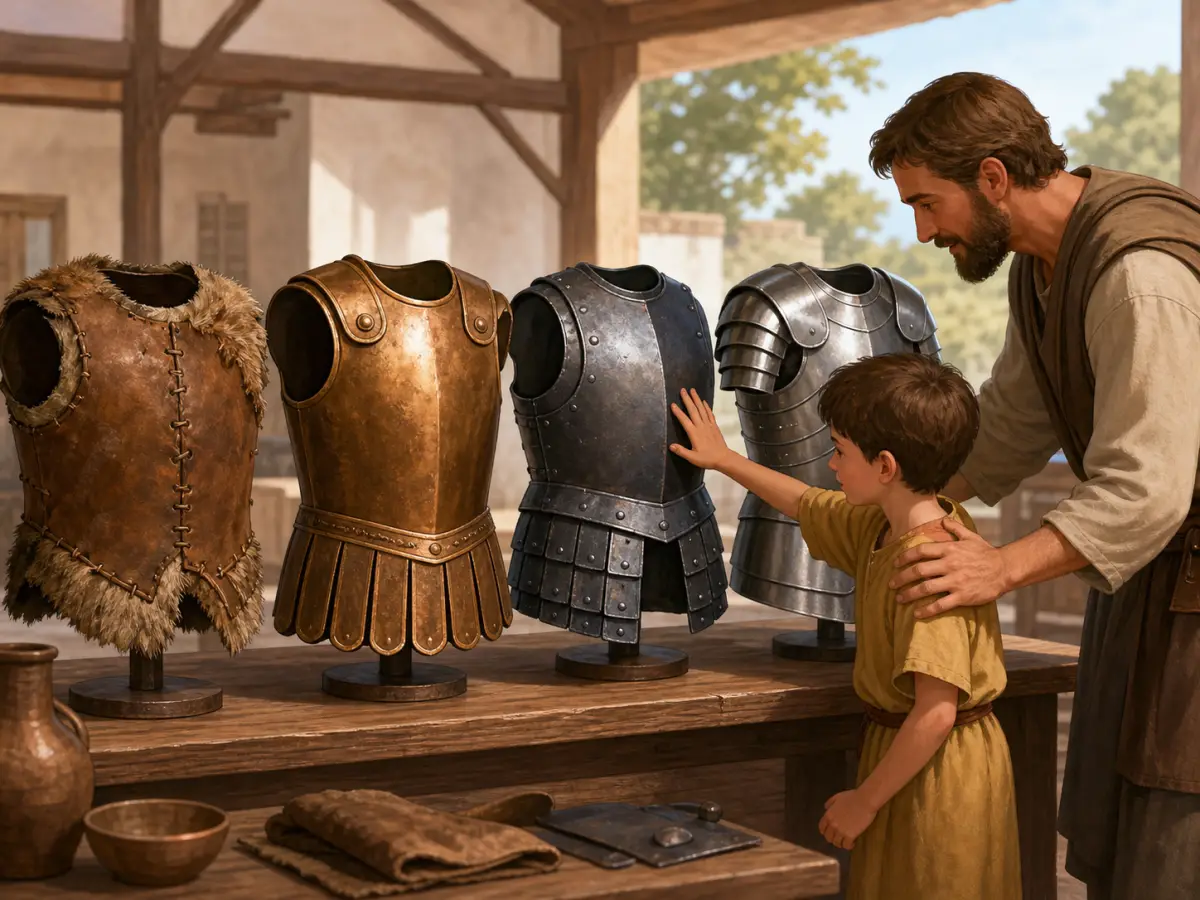
This misleading lineup uses several European-style solid breastplate shapes. It is not a Chinese dynasty sequence from hide to bronze, iron, and steel.
再看第四幅图:四件胸甲从毛边皮衣排到光亮钢壳,很像电子游戏里的装备升级。可是它们的轮廓更接近现代人对欧洲整块胸甲的想象,并不能代表中国历代铠甲。真正的变化往往发生在甲片大小、开孔方式、重叠方向、覆盖部位和编缀材料上,未必一眼就能排成“越来越亮、越来越硬”的队伍。
朝代名称也不能替代地点、兵种和用途。骑马的人需要肩臂活动,步兵可能更在意躯干和腿部覆盖,仪仗甲又可能重视颜色与装饰;边地和中原得到的原料与技术也不同。同一时代并存的差异,有时比两个朝代之间的差异还大。
Now look at the fourth illustration. Four breastplates march from a fur-edged hide vest to a shining steel shell, like equipment upgrades in a video game. Their shapes are closer to modern ideas about European solid breastplates than to a reliable survey of Chinese armor through the dynasties. Many important changes in Chinese armor involved plate size, hole patterns, overlap direction, protected areas, and lacing materials. They cannot always be arranged visually from “duller and softer” to “shinier and harder.”
A dynasty name cannot replace information about place, military role, and purpose. A rider needed free movement at the shoulders and arms. An infantry soldier might value more coverage over the torso or legs, while parade armor might emphasize color and decoration. Border regions and the central plains also had access to different materials and technical traditions. Differences within one time period could be greater than differences between two dynasties.
小结:先问结构,再问材料
In Summary: Ask About Structure Before Building a Timeline
看到一件古代铠甲,不妨像修复者一样依次提问:这是实物、图像、文字,还是现代复原?甲片用什么做成,怎样连接,保护哪里?它属于哪个地区、什么年代、哪类使用者?哪些部分已经找到证据,哪些只是最合理的猜测?
古代铠甲没有从皮到铜、铁、钢一路通关。它真正的历史,是工匠在有限材料中不断调整结构,也是考古学家从朽皮、锈块、孔洞和雕塑中,一片一片找回那些不同的答案。
When you see ancient armor, try asking questions like a conservator. Is this an excavated object, an image, a written description, or a modern reconstruction? What were the plates made from, how were they connected, and which parts of the body did they cover? What region, period, and kind of wearer did it belong to? Which details are supported by evidence, and which belong to the best reconstruction we can make for now?
Ancient armor did not advance through game levels from hide to bronze, iron, and steel. Its real history lies in the many ways craftspeople adjusted structures using the materials available to them. It also lies in the patient work of archaeologists, who recover the story one decayed scrap, rusted plate, lacing hole, and sculpture at a time.