
没有指板,二胡怎样找到音?
How Does an Erhu Find Notes Without a Fingerboard?
Page 1
手指到底按在哪里?
Where Do the Fingers Press?
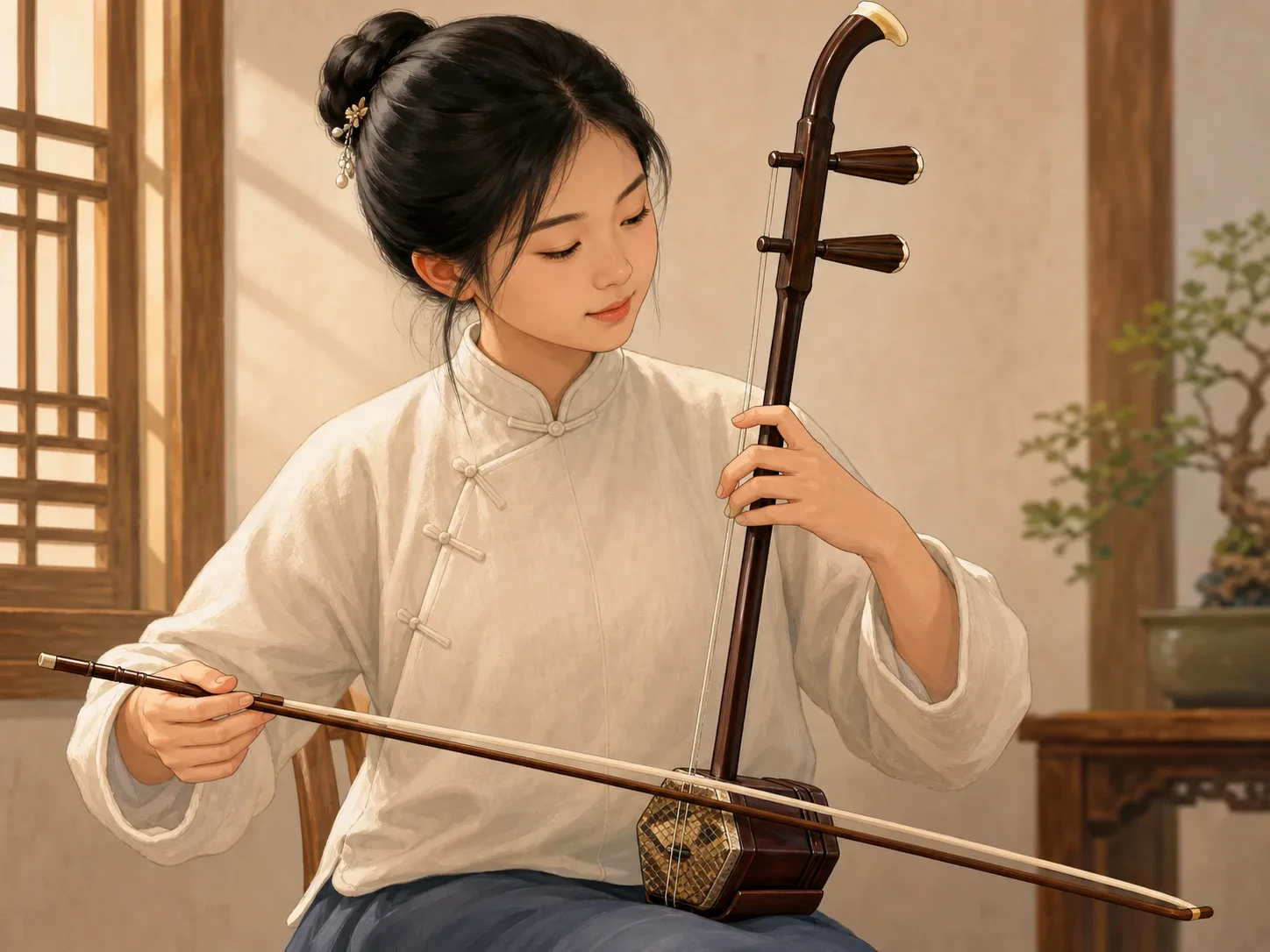
The left-hand fingers touch the strings with no fingerboard underneath.
èrhú · 有两根弦、用弓拉奏的中国乐器。只有两根弦。演奏的时候,左手要用手指按弦。可是仔细看看琴弦后面,那里没有指板。
手指轻轻抵住悬空的琴弦。稍微换一个位置,音就会变;沿着弦慢慢滑动,声音也会跟着滑过去。二胡也没有吉他那样一格一格的“品”,告诉手指某个音正好在哪里。演奏者要把位置慢慢练进手里,再用耳朵判断声音对不对。
这当然不容易。可是,也正因为没有一格一格把音锁住,二胡的声音可以弯曲,也可以从一个音滑向另一个音。有时候听起来,真的有一点像人在唱歌。
An èrhú · 二胡 · A two-stringed Chinese bowed instrument. has only two strings. A player uses the fingers of the left hand to stop them. But look behind the strings: there is no fingerboard.
The fingers touch the strings with empty space underneath. Move a finger even a little and the note changes. Slide it slowly along a string and the sound slides too. There are no frets telling the fingers, “This note goes exactly here.” The player has to learn those places by feel and use the ear to check them.
That is not easy. Yet the open space also gives the erhu something special. Its notes can bend and glide instead of only jumping from one to the next. Sometimes the instrument sounds almost like a person singing.
Page 2
为什么二胡的弓拿不下来?
Why Can't You Take the Bow Off?
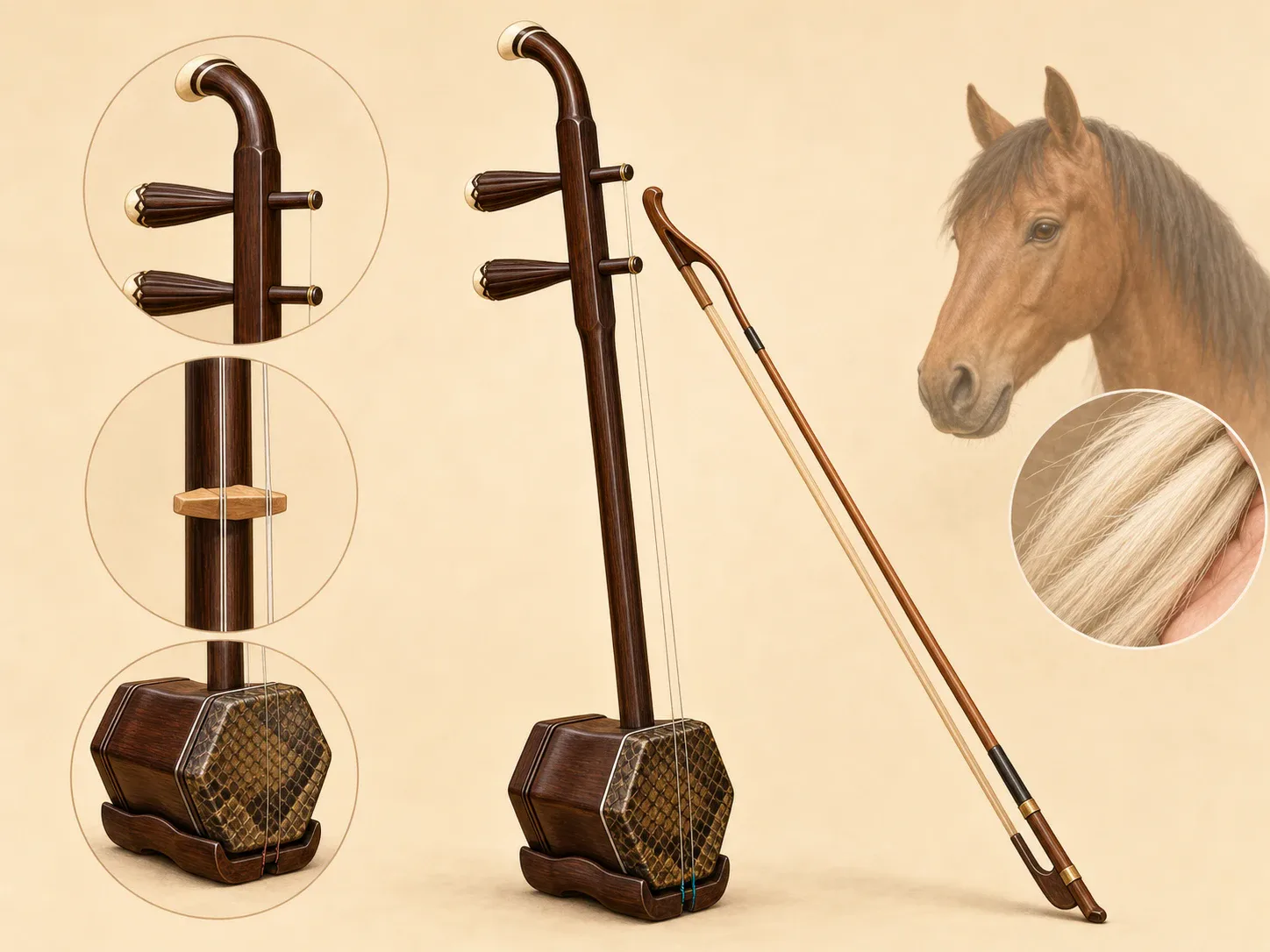
The sound box, neck, strings, and bow are separated for a closer look; while playing, the bow hair passes between the two strings.
再看看二胡的弓,还有一个奇怪的地方:弓毛是从两根弦中间穿过去的。所以它不像小提琴弓那样,放下琴以后随手就能拿开。演奏者把弓毛向里或向外压,就能擦响不同的弦。
琴弦振动以后,声音会通过一个小小的琴码传到下面的琴筒。琴筒前面蒙着一层薄膜,像小鼓的鼓面,也会跟着振动,让声音变得更响。许多传统二胡用蟒皮做这层膜。
二胡的主要部件看起来实在不多:两根弦,一把夹在中间的弓,再加一个小琴筒。可是到了会拉的人手里,两根弦已经能发出许许多多的声音。有一双手,后来特别有名。
Now look at the bow. Something else is strange: the bow hair passes between the erhu's two strings. It is threaded right through them, so the bow cannot simply be lifted away as a violin bow can. The player presses the bow hair inward or outward to rub one string or the other.
When a string vibrates, a small bridge carries the movement to the sound box below. A thin membrane covers the front of the box like the head of a tiny drum. It vibrates too, helping the sound grow louder. On many traditional erhus, this membrane is made of python skin.
The main parts make a surprisingly short list: two strings, one bow caught between them, and a little sound box. Yet in the right hands, those two strings can do a great deal. One pair of hands became especially famous.
Page 3
大家都叫他阿炳
A Musician Everyone Called Abing
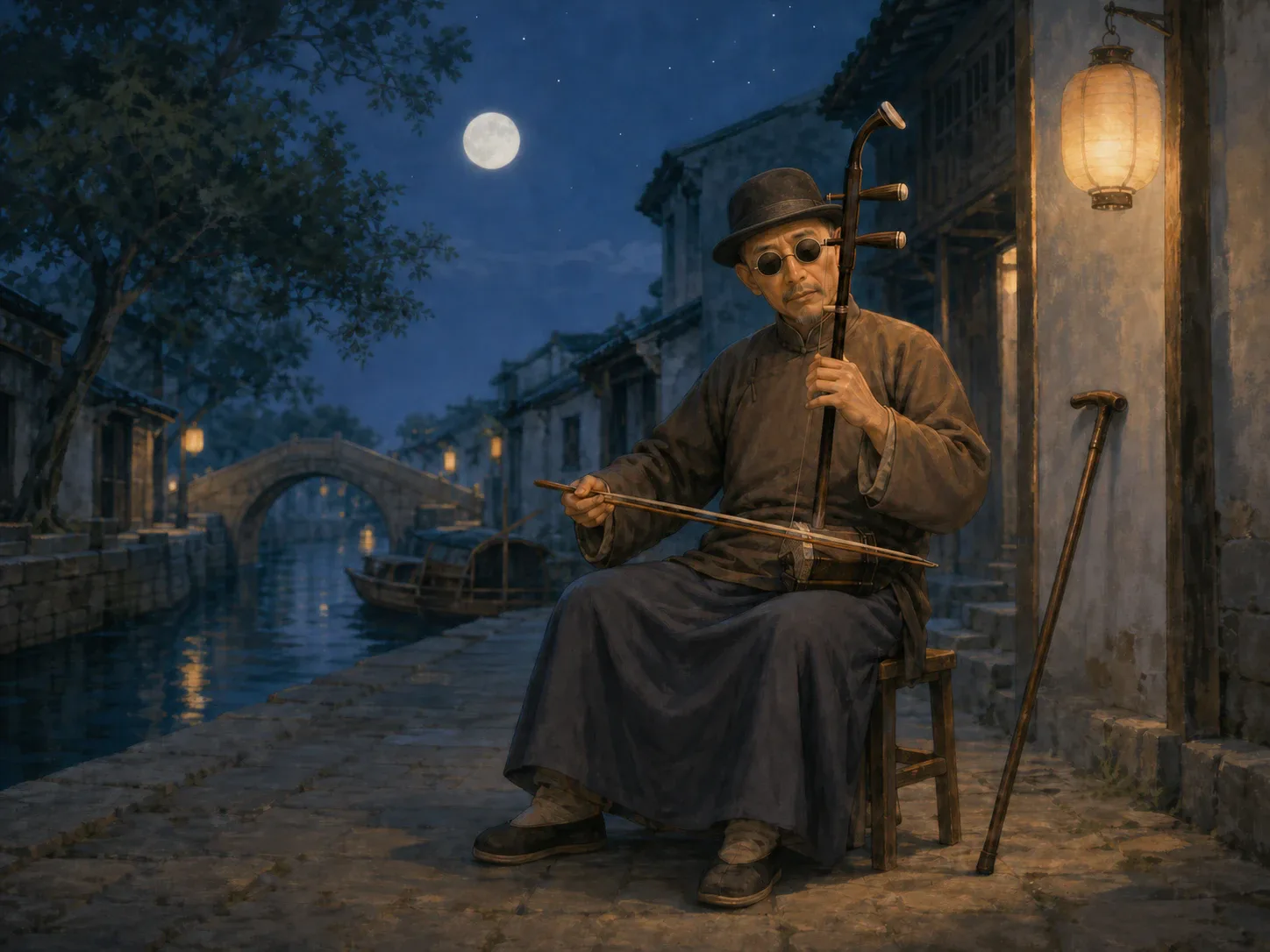
Abing carries his erhu through a moonlit waterside lane; no such visual record survives of the piece's composition or recording.
大约一百年前,Wúxī · 江苏南部的城市。有一位音乐家,名字叫华彦钧。不过,大家更熟悉他的小名:Ā Bǐng · 原名华彦钧,以二胡曲《二泉映月》闻名。。他从小学习音乐,后来双目失明,许多年里一直在无锡演奏。
他留下的二胡曲里,有一首后来以Èrquán Yìngyuè · 阿炳创作并演奏的一首著名二胡曲。闻名。想想我们刚刚认识的二胡:没有“品”把每个音固定住,手指可以滑,声音可以弯,弓上的力气也可以轻一点或重一点。两个人拉同一串音符,听起来仍可能很不一样。
乐谱能写下音符,却装不进一次演奏的每个细节。很长时间里,想听阿炳怎样拉琴,只能真的站在那里听。直到一九五〇年,有人带着一台当时很特别的机器来到无锡。那台机器,可以把声音留下来。
About a hundred years ago, a musician lived in the city of Wúxī · 无锡 · A city in southern Jiangsu.. His name was Hua Yanjun, but almost everyone knew him by his childhood name, Ā Bǐng · 阿炳 · The musician Hua Yanjun, remembered especially for the erhu piece Moon Reflected on the Second Spring.. He learned music when he was young. Later he became blind, and for many years he performed in Wuxi.
Among the erhu pieces he left behind, one became especially famous: Èrquán Yìngyuè · 《二泉映月》 · A famous erhu composition associated with Abing.. Think again about the erhu. No frets fix every note in place. A finger can slide, a note can bend, and the bow can press harder or soften. Two people can play the same notes and still sound very different.
A written score can show the notes, but it cannot hold every detail of one performance. For many years, if you wanted to hear how Abing played, you had to be there. Then, in 1950, researchers came to Wuxi with a remarkable machine. It could save sound.
Page 4
声音居然能装进钢丝里
Music on a Steel Wire
那是一台钢丝录音机。它不用后来常见的盒式磁带,而是让一根细细的钢丝从录音磁头前经过,把声音变成钢丝上的磁性变化。
音乐研究者杨荫浏和曹安和找到了阿炳。他已经有一段时间没有常常演奏,他们便帮他找来一把二胡,让他先练了几天。一九五〇年九月二日晚上,录音机里的钢丝盘开始转动,阿炳开始拉琴。
那天晚上,他们用钢丝录下了三首二胡曲,其中就有《二泉映月》。第二天,研究者又录下了三首琵琶曲。几个月以后,阿炳去世了。
乐谱可以告诉另一位音乐家要拉哪些音。可是那根钢丝还留下了别的东西:阿炳怎样把一个音滑向下一个音,怎样把声音拉长,又怎样用弓让两根弦发出属于他的声音。
那根钢丝已经很老了,阿炳也早已不在了。可是录音一响,我们今天还能听见他拉二胡。
It was a wire recorder. It did not use the cassette tapes that would become familiar later. Instead, a thin steel wire moved past the recording head, which stored the sound as changing magnetic patterns along the wire.
The music researchers Yang Yinliu and Cao Anhe found Abing. He had not played regularly for some time, so they helped him find an erhu and gave him several days to practice. On the evening of September 2, 1950, the wire spool began to turn. Abing began to play.
That evening, they recorded three erhu pieces on the wire, including Moon Reflected on the Second Spring. The next day, the researchers recorded three pieces played on the pipa. A few months later, Abing died.
A score can tell another musician which notes to play. The wire kept something more: how Abing moved from one note into another, how long he held a sound, and how his bow made those two strings speak.
The wire is old now, and Abing is gone. But when the recording plays, we can still hear his erhu.